Library music is the music written to be used. It goes into a catalogue, it is licensed without argument, and it turns up under a wildlife documentary, a cookery show and a nine o’clock thriller in the same week without anyone being told whose it is. For thirty years the record-collecting world has treated those catalogues as a seam to be mined — a source of breaks, of sleeve art, of a certain kind of unembarrassed melody.
Mining it skips the harder point. Library music was not just a supply of raw material; it was a form, and forms have rules. Brevity. Function. A cue that does its job and gets out of the way. A composer working inside those rules is doing something closer to writing sonnets than to being sampled.
Greg Foat writes inside them on purpose. He records for Sonoton, the library company, and releases the results commercially through his own imprint, Blue Crystal Records. He is also filed, routinely, under jazz — a shelf he has a certain amount to say about. He makes records at a rate that ought to be impossible and is not: this year alone brought Greek modal folk-jazz on Impressions of Samos, a woodwind and synthesiser record called Blobs that began with a birthday card, and Moving Images, cut with Frank Maston in a studio 1,300 metres up an Alp.
We sent him eleven questions and asked him to take them at whatever pace suited. What came back is unusually forthright, and in one place it is a straight refusal. Our fifth question assumed that playfulness is harder to write than melancholy. He opened his answer with “I disagree!” and then took the premise apart. He was right, the exchange stays exactly as it happened, and it is the best thing in the piece.
A library, not a film
Library music is usually treated as a source to be mined, which skips the harder point: it was a form with rules — brevity, function, a cue that does its job and leaves. What do those rules still ask of you on a Blue Crystal record, with no film to serve?
My music basically fulfils the same function. Library music is not made for one specific film (unlike Soundtrack music which is). Many composers do both and although they are similar in many respects, the disciplines are quite different. Library music albums are created to provide music which can be used for any number of television shows or films. The music is marketed as part of a library of instantly useable music without problematic licensing. Many of the most popular library music tracks have been used in multiple tv shows and film scenes over the years. Whereas Soundtrack music is commissioned for a specific film or television show or series.
As I now make records for the biggest music library company in the world ‘Sonoton’ I am technically a library music composer, although I am also known as a Jazz musician and composer, I have also made bespoke compositions for specific scenes in television shows. My label ‘Blue Crystal Records’ serves as a way for me to release the music (with kind permission from Sonoton) commercially on vinyl.
The world of library music has changed a lot in the past few years and as a result labels such as Sonoton have had to adapt to a relatively new found fame and wider audience. I have had meetings with Sonoton in which we have discussed that Library music is now recognised as having commercial success and viability outside of just production music. My albums reflect this new dynamic. I like to draw inspiration from the rich back catalogue of Library Music as well as many other influences such as Jazz, Ambient, folk, electronic, dance and world music.
1,300 metres up
Moving Images was recorded with Frank Maston at Ritmo Studios in Leysin, high in the Alps, in February 2025. Rooms are credited with a great deal on record sleeves. What did that one genuinely change about the playing?
In my experience location is very important in influencing how the music is created and Leysin was no exception. The village is 1300 metres above sea level. It was snowing and the air quality was incredible. The water was the purest I have ever tasted as the village has glacial spring water on tap. The studio was extremely well equipped, with a wide array of vintage analogue equipment and instruments, including a Wurlitzer Electric Piano and several vintage synthesisers. The owner and engineer Benoit was a pleasure to work with and the local restaurants near the studio were great offering a selection of traditional Swiss and international cuisine.
Three days, twelve tracks
You have said that you cannot be an egomaniac, and that opening yourself up is when the more beautiful things happen musically. Two composers who share a keyboard language can easily end up merely polite to each other. Where did you and Maston disagree?
I always try to give enough space for my collaborators to make them feel comfortable enough to facilitate their best performances. Maston and I have very different playing styles and composing skills so working together on this record was challenging for both of us. We had 12 tracks to record, edit and mix in only 3 days which meant we had little time to pause or reconsider things. There was no time for major disagreements and the music got finished very quickly. I think the music benefited from us working to a strict deadline and I am very happy with the end result as I think it is raw, spontaneous, honest and most importantly not over-produced.
What the shelf makes you expect
You once asked, plainly, who decides what the genre is. It reads more like impatience with the question than an answer to it. When a Greg Foat record is filed under jazz, what does that shelf make a listener expect?
To me jazz is more of a philosophy than a genre. So I would hope that people that listen to jazz are open minded enough to allow the music to take on many guises and forms, especially as Jazz is traditionally an art form which is deeply rooted in improvisation.
Generally though I find the idea of genres rather moribund and restrictive towards genuine creativity. People who label music need it to be labelled for their sake, so they can file it away. This does not benefit the music and can be reductive and restrictive, ultimately it means people are approaching an album with a already preconceived idea of what to expect. What good do those expectations do?
To me jazz is more of a philosophy than a genre.
”I disagree!”
Blobs is billed as ambient library music for woodwind and synthesiser, and it started from a birthday card your four-year-old drew for his mum. Playfulness is harder to write than melancholy and far easier to fake. What keeps a playful piece from turning arch?
I disagree! - why do you think playfulness is harder to write than melancholy? Every emotion is just a colour on a palette with varying shades and can be blended. I think every emotion in music should be a genuine reflection of the composers feelings.
This is especially pertinent now that we are living in the era of Ai. If you can create music via an app with a text prompt why bother making music at all? Unless music comes from a place of genuine emotional motivation through an instrument that a person can actually play I find it hard to appreciate. I have spent my entire life learning how to express myself emotionally and musically through my instrument.
Nowadays there are too many deluded, lazy people considering themselves as ‘musicians’ or ‘composers’ without ever learning an instrument or even playing a concert. I have little time for self proclaimed ‘artists’ or ‘musicians’ that do not play an instrument. This includes DJs that copy and paste other peoples music or pay session musicians to write their albums for them then take all the credit. They are fooling no one. No one really believes they wrote anything other than having a vague idea of how they want the music to feel.
The best music and art comes from people that have honed their craft. Their skill is a result of tens of 1000’s of hours of practise, of performances and of trial and error. The journey is just as important as the destination.
We can all too often view things as binary. In terms of Black and White. One or the other. The reality of human emotions is far more complex than just happy or sad. Music and art can reflect this complexity. ‘Blobs’ is an album of 9 compositions and many different emotions representing the characteristics of the nine ‘Blobs’ on the cover art.
I think my son drew some incredibly expressive faces within a beautifully simplistic form. He was 4 years old and it was his first complete picture he had ever drawn. It is a very special picture for me and his mum. I was inspired to make this album about the picture as I had already been commissioned by Sonoton to make an album of woodwind and Synthesiser ambient music. Serendipity works in mysterious ways and so they coincided beautifully.
The journey is just as important as the destination.
The bass that was not the plan
Elie Ghersinu’s bass runs through Moving Images as a more or less continuous anchor. An anchor frees everyone above it and also fixes them. What did the rest of the record stop being able to do?
Elie Ghersinu’s bass transcends simply being an anchor for the music. Elie’s bass is an integral part of the music. The album is a conversation between all three musicians built upon and fleshing out the skeleton forms of the compositions. Elie’s bass playing is so versatile that he can provide harmonic rooting as well as expressive melodic ideas.
The original plan was for just Maston and I to record as a duo. However Maston insisted on bringing Elie to the studio (I reluctantly agreed after much persuasion) and I am so glad he did. The dynamic between the three of us is exponential in terms of creativity and I personally found his playing inspired me to play some of the best music I have ever made.
I don’t think including the bass guitar stopped the record from doing anything except maybe stopping it being predictable. Elie’s playing brought so much character to the album and I have been working continuously with him ever since. We have recorded several albums together now and I honestly think he is one of the best bass players and nicest musicians I have ever worked with.
I personally found his playing inspired me to play some of the best music I have ever made.
Nearly forty albums
This year alone brought Greek modal folk-jazz on Impressions of Samos, a woodwind record for your son, and a library duo in the Alps. Those are three different rooms, not three batches of the same work. Do you keep them apart deliberately, or do they arrive already separate?
I love making albums. I always try to create an album I would like to have in my own personal record collection. I have a very diverse and eclectic record collection and each time I make an album I am aware of the pitfalls of repetition. I vary instrumentation, musicians and themes and to some extent studios. When I mix I try not to over use the same studio techniques and effects. I have made to date nearly 40 albums and each one is different.
Knowing when to stop
A cue written for picture has to end at the moment its function ends. A piece on Symphonie Pacifique is given no such instruction. Without that external stop, how do you know when something is finished?
In one word. Instinctively. In other words. Trial and error: Years of listening objectively, subjectively and almost being able to hear through your listeners ears.
It is a strange phenomenon that musicians have a tendency to play for either themselves or an audience. Excessive use of one or the other can lead to self indulgence or show boating. Neither are good for the music. I have some compositions that are over 10 minutes long and others under 1 minute long. Judging when to finish playing is something I have learnt through years of music making.
Years of listening objectively, subjectively and almost being able to hear through your listeners ears.
What an instrument will not do
Old keyboards refuse things. A Rhodes will not do what a sampler does, and a Moog has opinions about how it wants to be played. What has an instrument talked you out of?
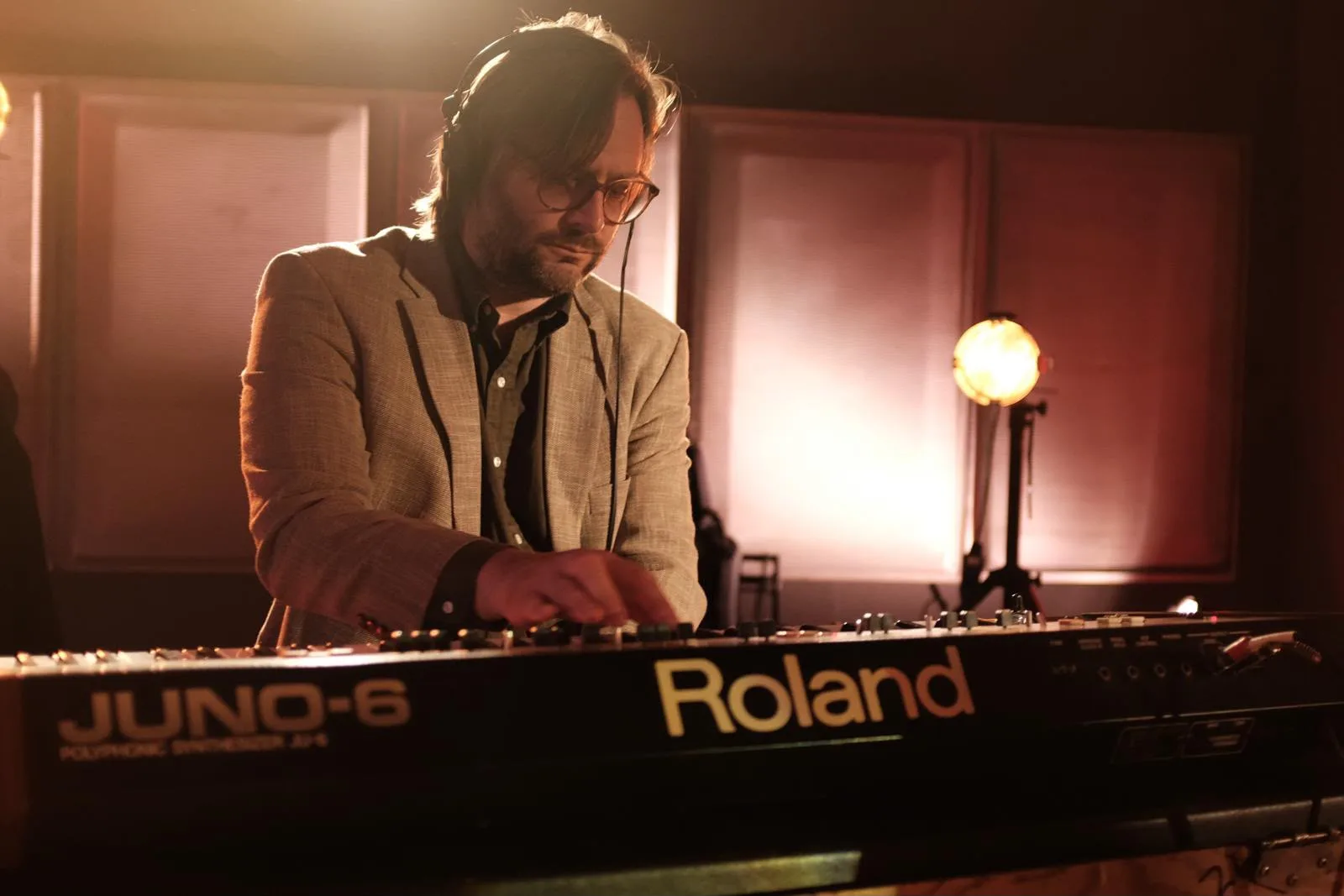
I don’t think a Moog has any opinions about how it wishes to be played, however I do think a keyboard’s limitations dictate how it needs to be played. A mono-synth can only play a single note and not chords. So arpeggios can take the place of fixed chordal harmonies.
The Wurlitzer in Ritmo Studios was in superb condition and perfectly in tune, which is quite rare these days. It had a fantastic action and that meant I could play very freely. Other old keyboards with bad action cannot give such freedom which can limit and/or prevent over playing (which is a common pitfall especially amongst jazz musicians)
Staying home
You have described being sick of touring, and glad to be in a stable home for once in your life. Staying still is usually written up as a loss for a musician. What has it given the music?
It has given me the stability and time to write more music. Touring only really promotes music, it can be very draining for musicians both physically and mentally. I am busy in the studio working on projects most weeks and I appreciate being able to spend time at home with my family. These past few years have been my most creative and productive of my career. I have been releasing 4 or 5 albums a year for the past few years which I would not be able to do if I was constantly touring.
Blobs, and other titles
Your titles carry a private, almost domestic humour — Spider Plant Blues, The Glass Frog, Blobs. A title is the last thing a listener meets and the first thing they carry away. What do you want a title to do?
My title choices are just a reflection of my life. My life is mostly domestic and I like to observe the humour in every day life. ‘Blobs’ is the title my son gave the characters he drew for his mum’s birthday card. ‘The Glass Frog’ is an art deco paper weight I bought in San Diego a few years ago and also a species of venezuelan rain forest frog. The studio had a cassette tape of field recordings which we used as background which fitted well with the Venezuelan percussion players rhythm.
Listen
Official site: gregfoat.co.uk
Photograph: Rachel Bird.
Continue reading
- Ancient Infinity Orchestra: what is alive in the room — another record made quickly, and what the room did to it.
- Jazz as an open method — the case for treating jazz as a way of working rather than a shelf.
- The album as a single argument — why a record can be more than the tracks on it.