In May, at the City Varieties in Leeds, Ancient Infinity Orchestra came back from the interval a few minutes late, and their leader explained why from the stage: sorry we were late returning from the break, we couldn’t find everyone.
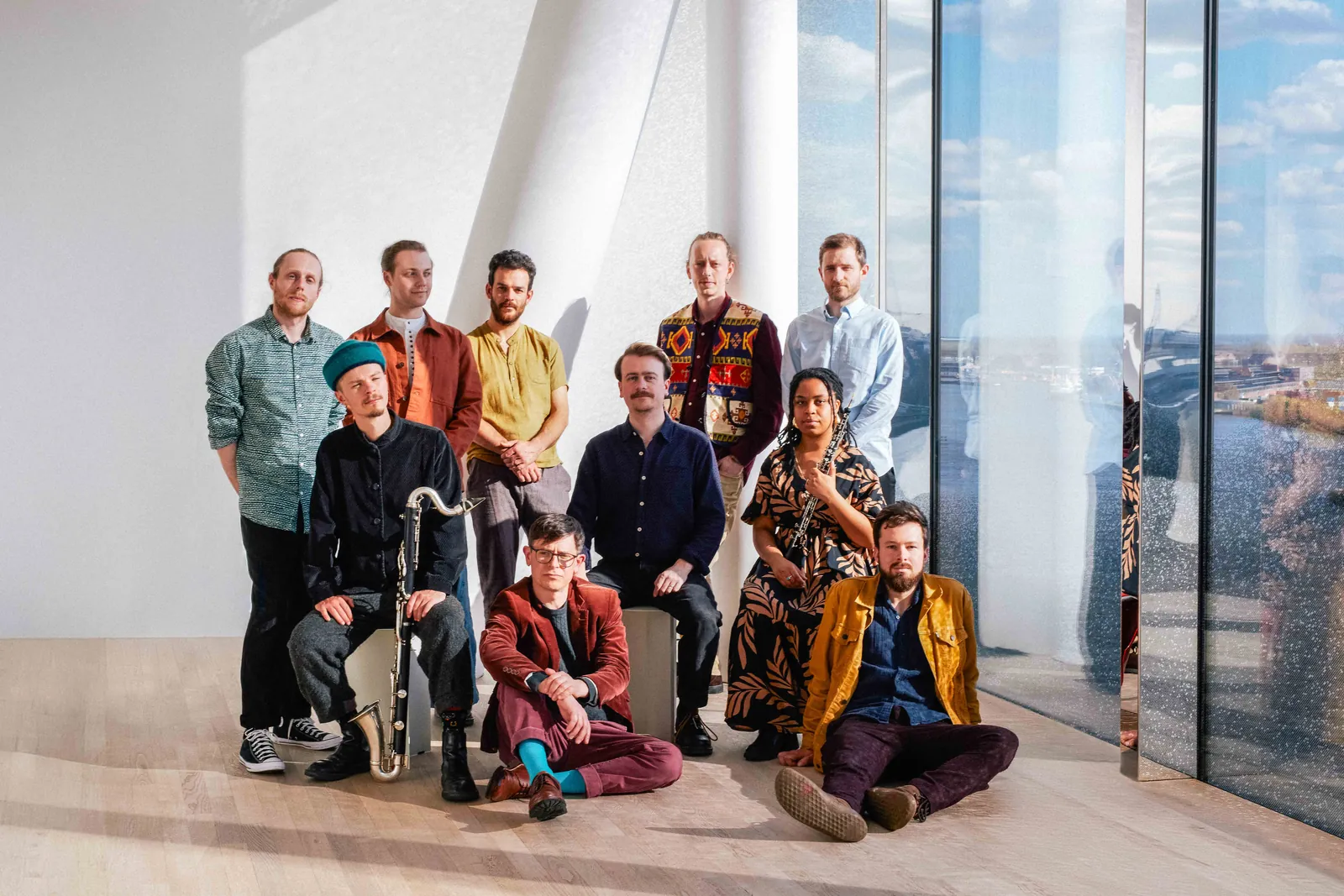
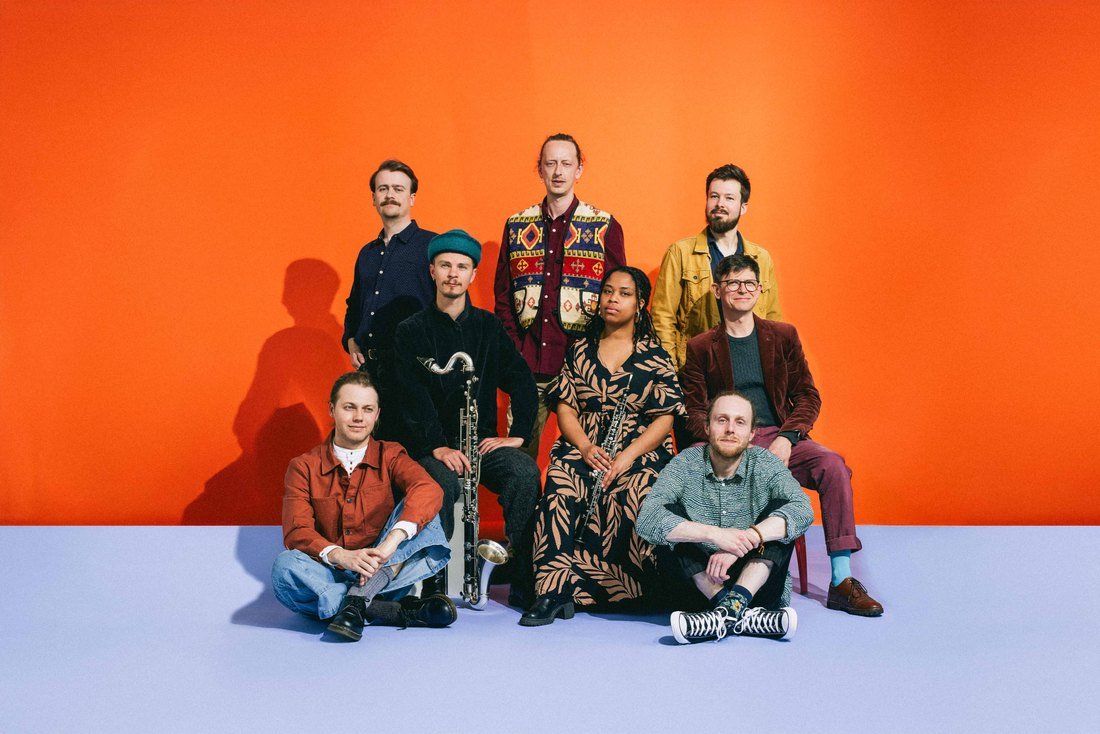
Twelve words, and the whole condition of the band is in them. Ancient Infinity Orchestra is an orchestra in the literal sense — something like fifteen or sixteen musicians on the records, eight in a rehearsal room on a good week, saxophones and strings and voices and several kinds of percussion at once. Almost every practical fact about music-making changes at that size. Where you can play changes. What you can rehearse changes. What the composer permits himself to write changes, because every extra line on the page is another human being who has to be free on a Tuesday.
Ozzy Moysey writes the music and plays the double bass. He is also, by his own cheerful admission, someone who did not practise. We wanted to talk to him because almost nobody asks large-ensemble leaders about the mechanics of the thing — the interviews go to how the band formed, where the titles came from, whether this counts as spiritual jazz. The craft of actually running an orchestra, week by week, out of a city in the north of England and without a gazillionaire behind it, goes largely unexamined. It turns out to be the most interesting subject he has.
What follows are his answers, written in his own time and lightly trimmed at his invitation. His new record with the orchestra is It’s Always About Liberation, on Gondwana Records.
”We couldn’t find everyone”
In Janne Oinonen’s review of the City Varieties show in May, you come back from the interval and say, from the stage: “Sorry we were late returning from the break, we couldn’t find everyone.” I have not stopped thinking about that sentence. It is the whole condition of your band in twelve words. How often does the practical reality of moving fifteen or sixteen people around actually reach the audience — and have you come to like it being visible, or do you still wish it weren’t?
I always speak to an audience as a whole in the same way I would speak to you in person. Perhaps in the past I would not have mentioned this and I would have entered a “performance mode”! I noticed I am at my most relaxed and in a better place to play music, however, when I just speak my own mind way more casually, whatever comes to my head in the moment. Sometimes this backfires and I may speak for too long, receiving a friendly nudge, or a helpful stifled cough, from a band member. But I want an honest connection — I want the people in the room to be fully invited in to the atmosphere.
Rather than a “performance”, I am more drawn to the idea that these occasions are gatherings that we are all here to experience as a full congregation, audience and musicians as one. It’s the connection in the room that is the most important thing. It’s more important than the music, but at the same time all of that love exists in the sound itself if we are doing our thing right. So if it’s on my mind I may say it — but we are very punctual! That venue was just very confusing back stage, and we were on home turf in Leeds, so maybe someone was catching up with a friend or family member, who knows! It’s fine by me.
The arithmetic
“There aren’t any good money reasons for having a 15 piece band,” you told Juno Daily. I’d like the unglamorous arithmetic of that, because readers who love this music almost never hear it — not the accounts, but what the number does to the writing. Does the size of the band change what you allow yourself to write? Is there a point at which one more part stops being a musical decision and becomes a decision about the band?
Let me also confirm that if money is the reason you’re even doing a small band — you are still making a mistake, because that’s not the music’s mission.
It definitely affects the way I write, having a large band, but I always hear a large band in my head. I love every single instrument, every musician I get to play with. It could be a smaller band… but what if we also had these people with us?! Firstly, not everything I write goes into this project. I have many outlets for composition. But even within the palette of Ancient Infinity Orchestra, we mix it up between highly arranged music and simple one-line melody compositions. Both work well with the group. The simplicity of a less arranged composition being played by experienced and wonderful improvisers seems to always go down well with us. This way we are all arranging on the fly — we trust each other. Sometimes we have a plan on the arrangement and how to approach it, but sometimes we break away from it if it feels right in the moment. There are some compositions that we only play when there are enough of us to pull it off.
An issue for the large-scale arrangements is that for one we are a group of very busy musicians in many different projects, but also, it limits the group to what venues we can play. There isn’t space to fit that many people on most stages even if we were all available for a show. We have done a few gigs with all of us. That’s a rare treat! Otherwise I am often writing in a way that the music will still work for 8 people but also for 16. Which is a huge limitation. But that’s also a challenge I enjoy. These musicians are so beautiful and versatile that sometimes we can just chat over what can happen at that moment gig by gig — that’s often how it goes.
People often say to me that they would have given up on a project of this scale a long time ago. I get that, and that’s why I have to also have other projects on the go, as the amount of organisation that goes into this band is pretty hideous. But when we are flying in the music together there’s nothing better for me, and I hope it carries on for as long as we want it to. It’s always worth the effort behind the scenes for the fleeting moments all together.
It’s always worth the effort behind the scenes for the fleeting moments all together.
An eight-piece core rehearses regularly now, and something like fifteen or sixteen make the records; in the older way of working, the people who turned up on a given day were a different combination each time. On paper that is unworkable. How do you rehearse music for sixteen with six in the room? Has the inconsistency itself shaped the writing — do you now compose parts that survive their own absence?
This is the biggest challenge for the group. We vary it. It does affect how I write for the group: I find myself having to pendulum between writing for the full band and then coming back to a more realistic version of the same thing. There are so many versions of the same tunes in my head that it can be a bit overwhelming at times, not knowing what to focus on. If I could always have everyone on the road together and at the rehearsals together I absolutely would. I’ve come to the (temporary!) consensus that it is best to write the full thing first — exactly how I envisage it in my dream world — and then do a more down-to-earth version. This is a bit heartbreaking sometimes, but until I’m a gazillionaire and can pay everyone’s salaries for being in the band, what else can I do? It’s hard enough to even get 8 of us in a room.
Those glory days of 14 hours of rehearsal a week were pre-partners, pre-children, pre-mortgages for some — you know how it is. But we are so lucky that we got that time in when we did, as the band is really riding off that time that we had. Even though a large amount of the current members were not there for that, they can feel that togetherness in the sound when we enter it together, as much as the original members do. But it also rides off our collective love for improvisation and the paths that are still untrodden and we are yet to explore.
If we end up at a rehearsal with 4 or 5 of us there is always something to do. Recently we did a 4-piece rehearsal focussing on percussion and different ways to approach a collective sound. I ask a lot of people to play all kinds of percussion. We have a lot of work to do with this but it’s an avenue I want to go down with way more attention in future. I love all those little sounds that you will hear when we play live as well as on the records. It’s another distinctive part of our sound — this dense ecosystem of different sounds popping out from all over the place. My first experience of improvising was in a rainforest-inspired improvisation in my primary school where we made our own instruments. I was also playing the balafon that my mum got for me when I was 4. That was my way into falling in love with sound, and this band keeps that initial experience of pure joy alive today some 29 years later. But yes — often it may get to a part in rehearsal where I’ll end up singing the missing part.
Every so often we try for a bigger rehearsal and rent a space so we can fit in. We are usually rehearsing with less in Joel’s bedroom though. Playing in a big U shape around his bed, which has heaps of percussion all over it.
Written for a person
You have described writing not for instruments but for people: knowing a player’s character and phrasing, deliberately making a part harder for someone who wants the challenge, giving more solo room to a player who took up their instrument only after joining. That inverts the usual order. What does a part written for a person rather than an instrument actually look like on the page?
These musicians are my friends and people that I love, first and foremost. I hang out with most of them regularly — I wish that I could spend more time with everyone more often than we get to. Because we are close as friends I am aware of what music they enjoy, I am aware of what I love about them and their playing. We improvise together in so many things within and beyond Ancient Infinity Orchestra. I also want every voice to have a chance to be heard.
If you hear our first album you’ll notice that there is not a great deal of attention on the strings — something I wanted to be conscious of for next time. I am learning as I go, writing-wise. There are not many other bands to compare to in terms of our instrumentation. When you have a viola and a sax playing at the same time, I’m realising now that a lot of the qualities of a viola are smothered by the frequencies of the sax. As much as I love lots of people jumping on the same melody together in unison, I am also trying to find more moments to open up to all of the subtle qualities that string instruments have. Some of the newer music that isn’t out yet is more informed by that thinking, I suppose.
There are a few people who have left the band and yes that can change things, but the tunes themselves feel different on different days so this is natural evolution. It’s also nice to try all of the different options that are available to us. If we could rehearse together more often, I would like to experiment way more with who plays what, but it is also quite a lot to ask someone to learn all of the other parts that they don’t usually play. It is an advantage to some of the simpler arrangements that we can adapt and vary things from gig to gig with more ease. Also I think often that the simpler the music is, the more of the individual’s voice we hear, as it’s easier for us to internalise what is written — and from there we can get to the real music making.
But yes, I think I pick who should play on each tune quite well, matching their sound to composition, and writing something else to feature someone else that I want to hear more of. How can I create an environment where they can show us their thing, without the composition smothering that voice, but holding them up for the world to hear, and celebrating them and their creativity.
How can I create an environment where they can show us their thing — without the composition smothering that voice, but holding them up for the world to hear.
You’ve said you’d like to explore both extremes: music as fully notated as Stravinsky, where every detail is handed to the musicians, and music given away entirely to the players so their personalities come out. Those are opposite theories of what a composer is for. Where does the present music actually sit between them?
Yes! I think the present music leans more in the direction of the latter, for sure. There is less pressure on these great improvisers when they can just do their thing. “Arc of the Sun” on River of Light is extremely written and it’s one of my favourites on the album, but every musician in the band is needed in order to play it, so we have probably only gigged it 2 or 3 times. As much as we love that tune, it’s just not practical to keep it in our repertoire. If we could get together more then that may be different. Gone are the days where we had two seven-hour rehearsals a week. With more open compositions, we have the ease of rearranging, keeping things fresh, and expanding from these small seeds of ideas to discover new places musically together. Some compositions come about as an album track idea, and we know that it will be a rare thing to play it live… for now at least.
When there are so many musicians and sounds available, it can be tempting to write all those details in to make sure they happen, but if you write less, I find that these details work their way in through improvisation anyway! And that way we are all crafting the thing together — I think it’s more engaging in that way. Also, if we can help it we won’t have charts on stage, so stripping back arrangements can allow us to memorise the tunes, internalise everything and be more present. It’s not what’s on the page but what is alive in the room.
Everyone in one room
You record with almost everyone in one huge room — not because there’s no alternative, but because you wouldn’t like it any other way — and then you spend real effort clawing separation back. And still the problem is bleed. So you are pulling in two directions at once. If you ever did win that fight and got clean isolation, what would you have lost?
Some of my favourite recordings ever have tons of bleed — like Coltrane pretty much playing into an open grand piano in the photographs. It’s part of the Gondwana Records sound to have excellent isolation. But there are not any studios with enough rooms that I know of to get perfect isolation. And that doesn’t feel good. I always want to be as close as possible to the people I’m playing with, but I also have to be in a place that is visible to the rest of the band. A lot of sections are cued by my head, whilst playing the bass!
The studio we use is The Nave Studios in Leeds, which is a massive room that fits us all in except the drums. There are not enough inputs in the desk to track everything live so we have to do the choir bits afterwards. Sometimes adding some extra percussion parts in an upstairs room, or adding a few little bits in afterwards. In a live setting the members of the band would just pick the percussion up off the ground in those moments, so any overdubs are deliberately limited and are made as realistically as possible. For example Joel may start a track, live, on flute but then switch to congas simply by walking over to them — but we can’t do that in the studio as he would have to open the big soundproofed studio door and run upstairs to the congas.
Sometimes the red light will be on and there is no way to adjust the headphone mix, and so you may do a whole take and not be able to hear the drums at all if you’re not careful. In that situation you just strap in and hold on tight and trust it will all come good. And it usually does. The same issues happen on stage, particularly at festivals. It’s just something that you need to be at peace with and improve for next time if possible, otherwise it will eat you up. There’s many things going against you logistically with our set-up, and so putting all that honesty and love into the sound you are making is the most you can do in some situations.
That high-quality recorded sound that Gondwana Records strive for, and that Tom Orrell, our sound engineer in studio, is so good at getting, does create a rare listening experience on record, as if you have an ear to each instrument. I have enjoyed hearing the results of that method even if it is a more challenging way of connecting to the people in the room whilst recording. It’s something that can take a bit of getting used to. There’s always a little pep talk and refresh of what the tune’s about so we get on the same page. We manage well I think. So far so good. It’s never felt too odd having John in another room. He takes on the challenge gallantly! And always makes us laugh down the headphones!
What a hand is saying
You conducted the thirteen-piece band on Jasmine Myra’s Where Light Settles in May, and I can’t find anywhere you’ve been asked about it. What does a conductor do in music like this — what is actually being communicated by a hand in a room where everyone can already hear each other? And what was different about standing in front of someone else’s music rather than your own?
In reality, even if you are in the same room, you often cannot hear each other. Particularly in a studio environment with baffles and headphone mixes. I suppose you become kind of the hive-mind when it comes to dynamics. My conducting and conduction experience has been restricted to mainly things that I have written in the past, and so I am not schooled in this particularly. I have my own ways of doing things.
I suppose my job is to know the music as well as possible and then try to embody every emotional aspect of the sound into a visual thing. You are not always being looked at if people are sight reading or partially obstructed by baffles, so I have to try and embody the more human qualities of the music that a piece of paper won’t. Like I said, I have no training in this, but the way I see it is that every musician playing is breathing this music. The conductor’s job is to get us all to breathe together as one organism.
Also, being in a studio is hard work. If you are on take 6 of something and you are trying to keep that same spark of fresh energy that there was at the beginning, I may end up even more animated with every take, until our next coffee break! But that band is so good — I did feel like I hardly needed to be there, but every little helps I guess. A lot of the time I would simply be marking out structures with a big down beat. Jasmine’s compositions and musicians glide together so beautifully anyway. I was mainly there to aid that line of sight. They smashed it. Check out the record.
Whether it’s my own music or Jasmine’s, I think it is a very similar experience to conduct it. Jasmine and I met up long before recording, and I asked all the questions about each and every section, so I suppose it is harder to internalise someone else’s chart, but I could connect with what she was doing on that album, and that is the most important thing. The writing is so great on the record that my job was easy really. It was pretty clear what I had to do.
What did I have to hold back? Nothing. I was there to serve her vision and I love that feeling. I think she was very happy with how it all came out so I’m happy about that too. What could I hear in Jasmine’s music that I can’t hear in my own? I can hear Jasmine’s wonderful personality in her music! We get on really well and we are both big fans of each other’s groups — we are Leeds chums after all. We shared the stage at Hackney Church and at Flagey in Brussels. More of those double bills please!
The conductor’s job is to get us all to breathe together as one organism.
The records almost nobody heard
You’ve mentioned a homemade record in 2018, with the CDs hand-painted and the sleeves made by hand, Arkestra-fashion. None of it seems to exist anywhere findable now. What was on it? Is the disappearance an accident, or do you think some music is meant to belong only to the people who were in the house at the time?
These were old Ancient Infinity Orchestra records. There was a series which was called Ancient Infinity Orchestra’s Cosmosaic, volumes one and two, and there were 2 other albums from the early days, Joy of a Natural World and Solar Seasons, and also an EP. Some of it is pretty wild. I’m really proud of what we did with that music.
Cosmosaic part 1 was called Things That Used to be on Earth, which was an hour-long dystopian future story with tons of spoken word. Many ideas within it were borrowed from Sun Ra’s writing and lectures. It was also inspired by some of Octavia Butler’s books as well as my own writing of course, including thoughts about what humans would do if they discovered a new planet to live on. It featured a 26-piece band following my hand signals for improvisers.
The second in the series, Moments in Time, was like a sonic timeline of 28 small compositions that flow in a continuous chain… from the big bang, to Earth forming in space, the oceans, the first plants growing, zooming along all the way to the industrial revolution, information age and so on. It’s a lot to take in and takes an hour and a half to listen to. Even though they were out for years, very few people had heard them, so we made a decision to start afresh and follow our new adventure with the label.
These tunes will inherently be a part of AIO’s DNA and story, so I think they will no doubt find a way to resurface live or on record in the future.
I should add that I lost hundreds of charts in a hard-drive catastrophe. But rather than re-writing old ideas up again, I’d rather focus on new stuff. It was kind of nice in a weird way — soon after the initial swearing my head off and walking in circles.
”Don’t practise, just play”
The best advice you say you ever had came from Jed Cutler when you were both eleven: don’t practise, just play. You have kept trying to live by it. But you now orchestrate for sixteen musicians and write parts detailed enough that people need the dots in front of them. Can a composer honestly hold that maxim? Where does it still apply — and where have you had to quietly break it?
Every time I try to get into a swing of playing the bass by myself, I end up discovering some little melody or fragment of something that I want to turn into a tune, so I end up just writing music instead. I still play the bass a fair amount but in completely improvised contexts. Ways that I enjoy playing, at this moment, are often with something very repetitive and trance-like, or with absolute freedom. That’s what has provided me with some of the most enriching musical experiences. You will hear in our music that I write a lot of repetitive bass lines, of course. That’s because I love that sound and I feel like I’m not in my head when playing. I feel present when I do that.
But it’s also probably because I am limited to what I can do. Due to lack of practise, I could never get out of my head in the same way walking through changes, on a standard for example. I guess I’m yet to find my freedom in that because I haven’t practised that much, even though I love that music. Others in the band are excellent at that. And so I seem to stay true to Jed’s advice, even now. There’s no right way of doing things.
There were a few years where I transcribed a lot of walking bass lines by some of the real legends and that did teach me a lot about harmony, but that felt like fun and like studying, not practise. I definitely expanded on what I could do on the bass in that time, but the most fun was when things got looser — trying new instruments, playing the drums and any horns we could get our hands on. We were in an improvised music band called Children of the Sun. That was a real post-music-college, necessary expulsion of energy, realigning with what was important to us about music and just letting a lot of pent-up expression erupt. Some of it ain’t pretty, some of it is, but the truth always comes out in the music and that was an important moment for all of us. We would play from 10pm till 3am non stop for about 6 months on all kinds of instruments, and then we all got a place together and played all day every day in a similar way for 3 years. It was exactly the kind of thing we needed at that time in our lives. It sounds exactly like the way we were living. We laugh about it a lot, but like I say it was also a very important part of our development as people and musicians. Thank goodness for music.
Steering back to your question, even though this is all related: I am open to the time that really practising my instrument in isolation, and maybe also transcribing stuff again, makes a return into my life. But I’m not good at doing what I don’t want to do. I would rather get together and play, at this moment in time.
I learnt to read music in reverse. I wiggled dots around on a computer software on the manuscript stave until it sounded right and I knew what it all meant, and learnt from friends along the way too. I still can’t read music at speed. I work slowly and I don’t know where all the notes are on the bass. But I’m having a great time.
There was a time where I used to beat myself up for not “practising”, but I then realised that if I actually wanted to do it then I would do it. I would find a way. What was actually happening was that I wanted to want to practise. And that felt like a silly thing to worry about. Plenty of other things to enjoy on Earth! We’ve already got too many things to do that we don’t enjoy. All music time for me has just ended up being doing exactly what I want to do and the amount that I want to do. If you live in a city as I do, Leeds, you can always find people to play with whenever you want.
What was actually happening was that I wanted to want to practise. And that felt like a silly thing to worry about.
The bass, and what he is listening to
The double bass came to you late — guitar first, and for years. Long before that, your second piano lesson was your last with that teacher: she asked you to use the right hand as well, you said you didn’t want to, and she said in that case she wouldn’t teach you. So: what does the bass let you do that the guitar never did? And when you’re playing something simple and repeating while the rest of the band moves around above you, what are you actually listening to?
Exactly! I didn’t do what I didn’t want to do. So the road ended there, temporarily. I still obviously sucked with just my left hand, so a better teacher could have squeezed a bit more blood out of that stone I reckon, or at least nurtured what was there, rather than having a standard model for all students and trying to bring everyone to the same thing. I’ve not done much teaching but if I did I would be careful to lift up what already exists rather than pull them away from their individuality. I’m too scared of ruining the fun for people. But friends in the band often talk up a kind of dream music college where we do things in a very different way to what we have experienced. Unfortunately places need to follow some sort of syllabus to get the money to pay the staff. We could have a real culture of creative music if we didn’t have to jump through hoops that kill creativity.
The double bass for me was just a sound I always loved, but was an instrument I started to hear more in the music I loved later on in life and eventually I had to get one. My mum bought me it. It was a plywood one, cheap for a double bass, but it was set up really nicely. It’s been more and more in the wars recently and I have just bought my first proper bass just a month ago, which I’m getting repaired tomorrow! It just needs a few tweaks but it’s a proper wooden bass at last. That plywood one served me well though, but it’s become a little unreliable. I got some funding for creating new written music techniques for improvisers last year and all the money that I paid myself to work on that is now splurging on that beauty. It’s so nice I can’t believe it.
It just has a sound that I love. I like the ancient feeling that it conjures in my imagination. It reminds me of tree roots, of the earth. It’s mysterious and can be menacing, it can be like whale song. It feels great to stand up and really lean into it, as it’s such a physical instrument. It’s just different. I still love the guitar, but for me, post playing Guns N’ Roses riffs as an 11-year-old, it soon just became a tool for composition, as you can hear full chords on the guitar with all the extensions, and it is easier to sing something else over the top of what you are doing. I still write on guitar sometimes. I like writing on guitar or piano as you can sit down easily and write something down and play or sing again and write the next bit down. It can slow down the speed a bit when you have to put down a whole double bass and pick it up again, but I do that too.
The other question was what do I listen to whilst playing something simple and repetitive. It varies I think, and it “flickers”. Music is like a meditation in many ways and a lot of what happens is from the subconscious. Sometimes I’m listening very actively to the sounds around me. Sometimes I trust my subconscious ear and hone in on exactly what I am doing.
But at the same time, I really resonated with what William Parker said in one interview, which was something along the lines of: in the middle there are the physical sounds and vibrations of the instrument and of the ensemble. In the periphery, however, on the left-hand side you have LOVE, and on the periphery on the right-hand side you also have LOVE. So in the centre you kind of hear that, but what you are focusing on is the periphery. When I heard him say that, it was the first time I had heard the feeling of playing music described that well with words. At least in a way that resonated best with me and my approach.
But of course other things creep into the mind all the time, just like with meditation — “am I out of tune?”, “I wrote this music and I can’t even play it!”, “Does everyone know what comes next in this tune?” — but then you flicker back to bliss states of presentness again. It’s something to work on like anything else, and surrendering to the moment sure ain’t an easy thing. But that’s ok! We are all human.
Listen
Band: ancientinfinityorchestra.com
Photographs by Yvonne Schmedemann, courtesy of Gondwana Records.
Continue reading
- Silence in music: the pause is not emptiness — why the rest and the decay belong to the music, not against it.
- Why slow music reaches deeper — the physiology of tempo, and why a single unhurried line can hold a whole room.
- aus: what survives when the recording is gone — another composer on rebuilding music after a hard loss.