The most useful thing to understand about jazz is that it is not a single sound. It is a method of making music. The Smithsonian’s introductory definition describes jazz as a music in which improvisation is typically important, often featuring swing, blue notes, and rhythmic momentum. Britannica adds the African American origins of the form, its shaping by European harmonic structures and African rhythms, and three traits that are usually mentioned together: improvisation, syncopation, timbral individuality. Those three traits do most of the work in any honest definition. They also explain why jazz has been able to absorb almost any musical idiom it has met, and why it remains one of the most porous and expansive musical languages on the planet.
UNESCO’s framing of jazz as a universal language of freedom, creativity, peace, and intercultural dialogue is the public-facing version of this same observation. The form is not closed. It cannot be closed without becoming something else. That is what makes it interesting as a method, and what makes it difficult to write about responsibly: the writing has to leave the form room to do what the form does.
What improvisation actually is — and what it isn’t
The popular caricature of improvisation is that it is musical free association: the player makes things up. The literature is more precise. A 2008 PLOS ONE fMRI study by Charles Limb and Allen Braun scanned six professional jazz pianists and found improvisation associated with a distinct pattern — deactivation in parts of the prefrontal cortex linked to self-monitoring, alongside increased activation in medial prefrontal regions connected with self-expression. Johns Hopkins’ summary of the same work emphasised the link to individuality and storytelling, and it is from that summary, rather than from the paper, that the popular version descends: the musicians switch off their inner critic.
That version has travelled a great deal further than the evidence under it. Six is six, and the authors say so plainly, describing their group as a relatively select population. A year earlier Fredrik Ullén and colleagues had scanned eleven pianists improvising and then reproducing what they had just played, and found the right dorsolateral prefrontal cortex more active during improvisation, not less. The same region, the opposite sign — because the two studies were comparing improvisation against different things. What a scan reports depends heavily on what it is held up against.
So the inner editor is a metaphor, and it is better kept as one. It is a good metaphor: it matches what players describe and what the recordings sound like. But it is a description of the experience, not a mechanism that six scans established, and the distance between those two is where most writing about creativity and the brain goes wrong. What survives is narrower and still worth having — improvisation is not a smaller version of playing something learned, and the difference shows up in the brain and not only in the ear. The corollary holds either way: bad improvisation is not improvisation that breaks rules; it is improvisation in which nothing was risked. The state, not the technique, is the load-bearing element.
Jazz feels alive because what you are hearing is not a performance of fixed material. It is thought, risk, and identity emerging in front of you, with the technical scaffolding that lets that emergence stay coherent.
This is also why jazz musicians spend so many years on technique. Technique is not the music. Technique is the floor that has to be solid before the editor can relax safely. A player whose technique is shaky cannot afford to drop the inner monitor, because dropping it will produce mistakes the room will hear. A player with a deep technical foundation can let the editor go and trust that the floor will hold.
Why the form can hold so many idioms
The same three traits that define jazz — improvisation, syncopation, timbral individuality — also explain its porousness. Improvisation is a method that can accept any harmonic system as input. Syncopation is a rhythmic instinct that can be layered onto almost any metre. Timbral individuality is a value: it asks each player to sound like themselves, which means any new instrument, idiom, or sonic vocabulary can enter the room without having to be filtered through a fixed style.
That is why the form has been able to absorb Cuban clave, Brazilian samba, North Indian raga, Andalusian flamenco, Eastern European folk modes, contemporary classical harmony, hip-hop production, electronic textures, ECM-tradition Nordic restraint, and Japanese silence aesthetics — all without losing the essential character of being jazz. The form does not require a fixed sound. It requires a relationship to improvisation, rhythm, and personal voice. Any musical material that respects those three commitments can be folded in.
This is why “jazz is one of the most expansive musical languages in the world” is the responsible claim, while “jazz is the widest style” is the harder one to defend. Expansive is a quality of the method, and it is supportable. Widest is a quantitative ranking, and it is not easily measurable.
What happens to a listener
The science of listening to jazz, as opposed to playing it, is less concentrated than the science of improvisation itself, but two broader findings transfer cleanly. A 2023 meta-analysis of randomised studies on musicking found a small-to-moderate positive overall effect on emotion regulation, with the strongest evidence for self-selected, preference-aligned listening. A Nature Neuroscience study found that intensely pleasurable music engages reward circuitry — including dopamine release — during both the anticipation of emotional peaks and their arrival. Both findings are relevant. Jazz is a music whose entire idiom is built around managed anticipation: a soloist is constantly setting up expectations and either fulfilling them or, more interestingly, declining to. The listener who lets the anticipation run is precisely the listener inside the reward arc the Nature Neuroscience paper describes.
That is also why the right occasion matters. Jazz is not a single emotional offer; it is a method that can be tuned to many different listening conditions. The same player, the same band, the same album, can be the right music or the wrong music in two different rooms.
Occasion-fit, not as science but as editorial advice
What follows is editorial, not experimental. It is not a research finding to claim that cool jazz fits a slow morning. But the editorial pairings below have held up well in serious listening culture for decades, and they are worth offering in print rather than left as assumptions.
- Mornings — cool jazz, bossa nova, light piano trio. Unhurried, breathable, low harmonic urgency. The music does not insist on the day yet.
- Focused work — piano trio, modal jazz, ECM-tradition Nordic recordings. Predictable harmonic frames, minimal lyric, room for thought.
- Dinner — vocal jazz, standards, swing in lower gears. Music that does the social work of holding a room together without taking over the conversation.
- Romance — ballads, slow tempos, intimate vocal recordings. Music that gives an emotional state a tempo to inhabit rather than supplying it from the outside.
- Gathering and celebration — swing, big band, New Orleans tradition. Music whose architecture is collective, whose pulse organises bodies.
- The city at night — darker modal jazz, hard bop, post-bop with edge. Music that reads urban late hours honestly without sentimentalising them.
- Friction and demand — free jazz, abstract improvisation, AACM-tradition work. Music for listeners who want the room to feel different when the record finishes.
The point of the list is not that jazz is segmented this way. The point is that the form is wide enough to meet radically different human situations without changing what it fundamentally is. That width is the editorial argument for it, and it is what makes the form worth defending in 2026.
What a listener can bring
A small word on listening posture. Jazz rewards attention not because the music is difficult, but because most of the interesting work happens at the level of phrasing, internal voicings, and rhythmic placement — small choices that a half-attentive listener will not catch. A good way in, for a listener who has not spent years inside the idiom, is to pick one element per piece and follow it: the bass walk on this track, the cymbal touch on that one, the way the pianist’s left hand answers the right. The first time the choice you have been following changes meaningfully, you have heard the piece.
That posture — follow one voice for the length of a track — is also a defensible piece of listener advice for almost any music with internal complexity. Jazz happens to be the form that rewards it most directly, because the form is structured around the visibility of individual choices.
A closing note
The honest version of “why jazz matters” is not that it is the highest music, or the freest, or the most authentic. The honest version is that jazz is one of the few large musical forms that takes individuality and method seriously at the same time. It demands real technique and then asks the player to be themselves inside that technique. It builds a shared frame and then leaves room for a single voice to disturb it. It accepts almost any cultural input and turns the input into a contribution rather than an interruption.
That combination — discipline and openness, held simultaneously — is not common in any human practice. Jazz has been doing it for over a hundred years. That is a fact worth listening to.
Sources
- Smithsonian — What is Jazz?, americanhistory.si.edu.
- Britannica — Jazz, britannica.com.
- PLOS ONE — fMRI study of improvisation in jazz pianists (Limb & Braun, 2008), journals.plos.org.
- Johns Hopkins — public summary of the Limb & Braun improvisation study, and the origin of the “switching off the inner critic” phrasing.
- Journal of Cognitive Neuroscience — “Cortical Regions Involved in the Generation of Musical Structures during Improvisation in Pianists” (Bengtsson, Csíkszentmihályi & Ullén, 2007), direct.mit.edu.
- Nature Neuroscience — “Anatomically distinct dopamine release during anticipation and experience of peak emotion to music” (Salimpoor et al., 2011), nature.com.
- UNESCO — International Jazz Day framing of jazz as universal language.
- Music and emotion regulation — 2023 meta-analysis of randomised studies.
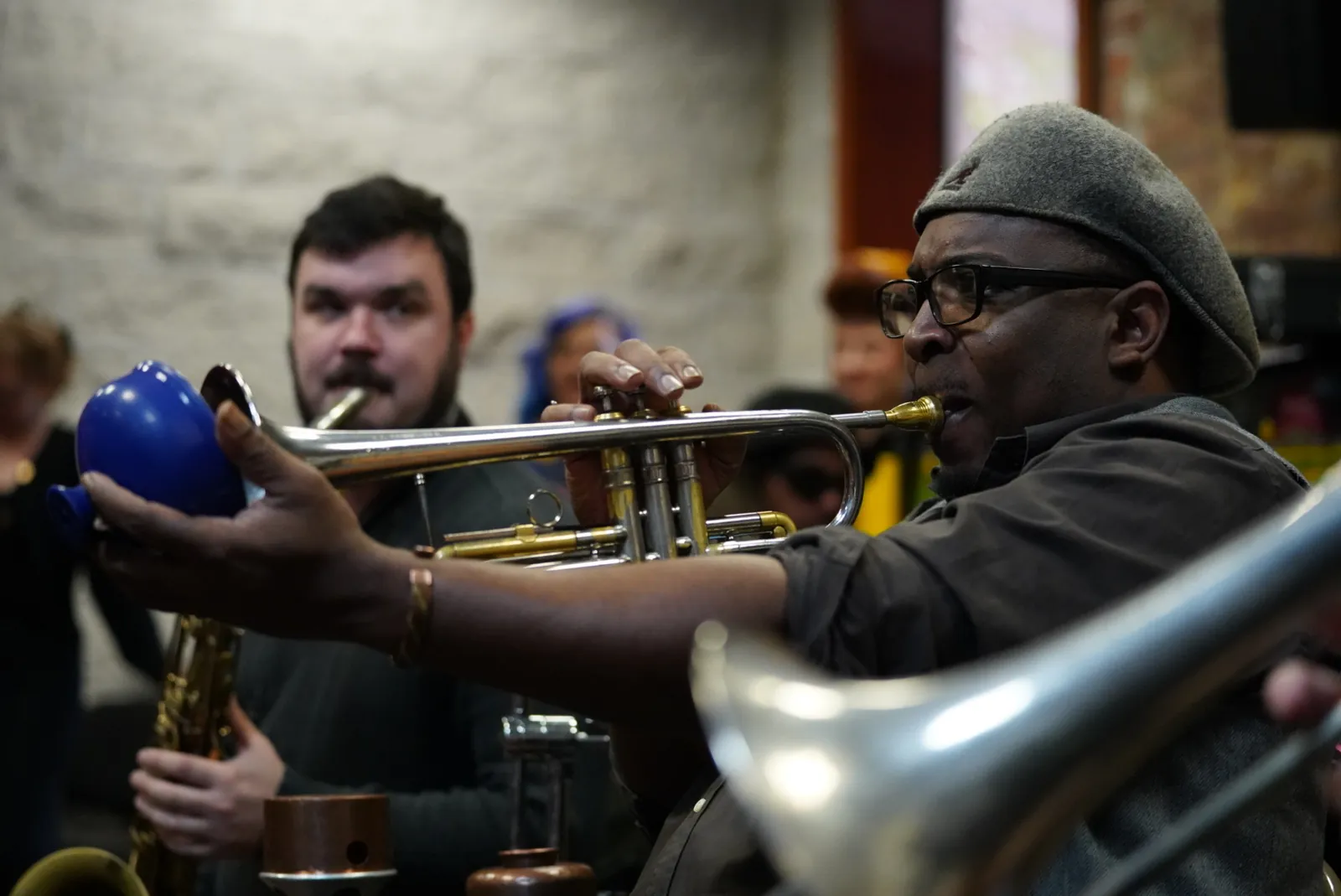
- Hero photo: “Trumpet Player’s Expressive Performance — New Orleans Jazz NHP” by Hunter Miles Davis / NPS, via Wikimedia Commons, Public domain.
Continue reading
- Why complex music sharpens creative listening — the cognitive case for music that asks for more than passive attention.
- Lo-fi for coding and reading: why it helps — but not the way you think — the opposite extreme: music engineered to recede.
- Why slow music reaches deeper than it seems — the body-side physiology of music that gives the listener time.