There is an experiment most people have run on themselves without meaning to. You are somewhere ordinary — a supermarket queue, a borrowed car — when a song you have not chosen and have not heard for fifteen years starts playing. Before the first chorus you are somewhere else: a specific kitchen, a specific summer, a person whose voice you had not thought about in a decade. The memory does not arrive as a fact, the way a diary entry would. It arrives furnished — light, weather, the feeling you had then, and underneath it the disquieting sense of briefly being the person you were.
Photographs are supposed to be our technology for this. We take them precisely so that moments will survive. Yet a photograph of that same summer tends to do something different and smaller: it shows you the moment from outside, confirms that it happened, dates the haircut. The song puts you back inside it. This difference is not sentimental folklore. It has been measured.
A head-to-head test
In 2016, Amy Belfi, Brett Karlan and Daniel Tranel published a study in Memory with an elegantly blunt design. Participants listened to thirty songs and looked at thirty photographs of famous faces — two of the most potent memory cues ordinary life provides. Whenever a cue called up an autobiographical memory, the participant described it, and the descriptions were scored with a standard method that separates internal details (what happened, where, what it felt like — the episodic tissue of a memory) from external ones (general facts, commentary, things that belong to other memories).
The two kinds of cue were both effective. But they returned different goods. Memories evoked by music were more vivid: richer in internal detail, and in perceptual detail specifically — the texture of the scene, not just its caption. Memories evoked by the faces carried more external detail — more knowledge about, less being in. A photograph, even a resonant one, tends to retrieve the file. A song tends to replay the event.
The precision matters, because this finding is often inflated into “music brings memories back faster”, which the study did not test and did not claim. What it showed is narrower and more interesting: when both kinds of cue work, the music-evoked memory is the one with the furniture still in it.
The archive does not have a search box
Why should sound outperform sight at this? Part of the answer came seven years earlier, in one of the field’s founding papers. In 2009, Petr Janata at UC Davis scanned listeners while they heard short excerpts of popular songs from their extended childhood — and rather than asking them to search for memories, he simply let the songs do what songs do, and watched. When an excerpt struck an autobiographical vein, a region along the top and front of the brain — the dorsal medial prefrontal cortex, long associated with self-referential thought — tracked the memory’s strength. More remarkably, the same region tracked the music itself, following its movement through tonal space on a timescale of seconds.
Two things about that result deserve emphasis. The first is the anatomical one: music and the sense of self are being processed, at least in part, in the same place at the same time — a plausible sketch of why a chord change can feel like a change in who you are. The second is procedural, and easy to miss: the memories in Janata’s scanner arrived under what he called low retrieval demands. Nobody was trying to remember. This is the signature quality of music-evoked memory in everyday life, and the reason it feels less like using an archive than like being ambushed by one. The photograph album requires you to go looking. The song comes looking for you.
A date written into the sound
In 2026, Husein and Fernandes at the University of Waterloo added the most practically illuminating piece so far, in a two-part study in Aging, Neuropsychology, and Cognition. First they took popular songs from participants’ youth and dismantled them — playing some intact, some as instrumentals, some as lyrics alone, some reduced to the song’s name on a screen. Intact songs were the most effective memory cues: the whole recording, voice and arrangement and grain together, outperformed its own ingredients. And the memories that came back aligned in time with the song’s moment of popularity — a track from one particular year tended to retrieve that year.
Their interpretation is quietly beautiful: a song works as a memory cue because it sets a temporal context. It narrows the search to one stretch of your life before conscious remembering has even begun. A photograph pins one scene; a hit song pins a season — and everything you did inside it.
Then came the finding that ran against decades of assumption about ageing. In their second experiment, songs cued more autobiographical memories in older adults than in younger ones — not fewer. The authors’ suggestion is that this is exactly what you would expect if songs carry their own context: recreating context is one of the things that ageing episodic memory finds hardest, and the song simply hands it over, ready-made.
Why sound, and not sight
Set side by side, the three studies sketch an answer to the larger question. Photographs are records of how things looked, taken at occasions — the birthday, the beach, the graduation. Songs are records of how time felt, absorbed during the unphotographed hours that make up almost all of a life: the commutes, the kitchens, the falling asleep. A photograph was present for one minute of the past. The song was present for hundreds of them, and it binds what psychologists would call state — mood, season, the whole weather system of a period — rather than a single scene.
And unlike the photograph, the song is an event. It unfolds in time, the way the remembered life did; it engages prediction and body and emotion at once, as we have written about re-listening; and it reaches the self-referential cortex directly, without asking permission. Melancholic music in particular seems built for this double duty — feeling and archive at once.
None of this should be overclaimed. The research here is about healthy remembering — the ordinary, startling vividness of a life returned by sound — and a more vivid memory is not always a more accurate one; vividness is a feeling about a memory, not a certificate. What the evidence supports is modest and strange enough as it is: of all the things we made to hold our past, the ones that hold it best were never meant as records at all.
The tape at the bottom of the box
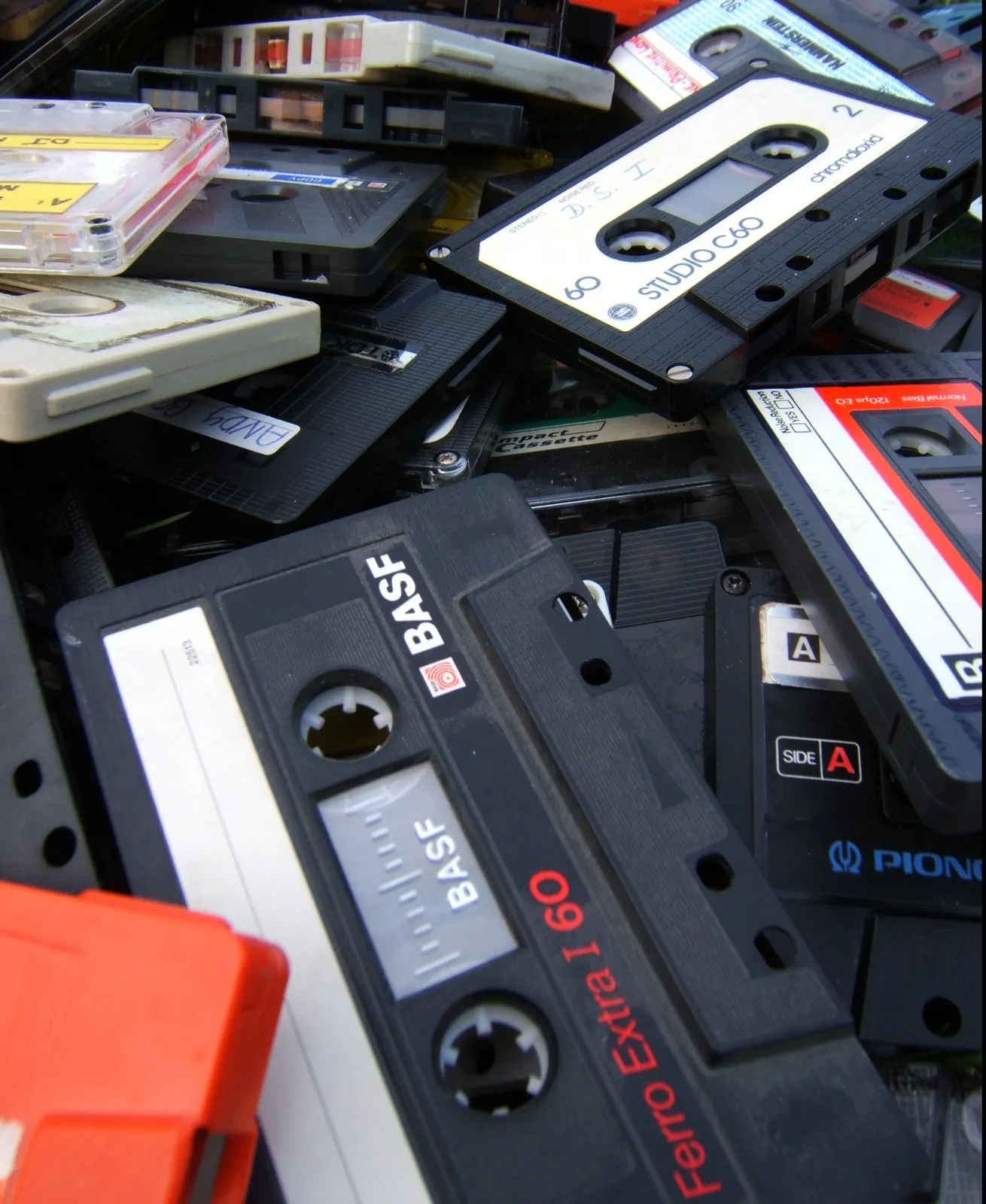
Which suggests a practical conclusion so old-fashioned it barely sounds like advice. The photographs are safe; every phone now guards them jealously. It is the listening that goes unarchived. The album you wore out in one particular flat, the mixtape somebody made you, the playlist of a single strange spring — these are retrieval keys to versions of yourself that nothing else will reopen, and they are easier to lose than pictures: formats die, services close, titles slip the mind.
We will not embed a song at the end of this essay. For once it would be beside the point. The recording that opens your archive is not the one that opens ours — it is at the bottom of a box somewhere, hand-labelled, waiting to be played.
Sources
- Belfi, A. M., Karlan, B., & Tranel, D. (2016). Music evokes vivid autobiographical memories. Memory, 24(7), 979–989. tandfonline.com.
- Janata, P. (2009). The neural architecture of music-evoked autobiographical memories. Cerebral Cortex, 19(11), 2579–2594. academic.oup.com.
- Husein, K., & Fernandes, M. (2026). Popular songs evoke autobiographical memories in younger and older adults: specifying the source. Aging, Neuropsychology, and Cognition. tandfonline.com.
Continue reading
- On re-listening: how a song becomes yours — the mechanics of how repetition turns sound into personal property.
- How melancholic songs shape emotion and memory — the emotional side of the same archive.
- Why music gives us chills — and why some of us get them more than others — what happens when a remembered swell reaches the skin.