In 1995 the psychologist Diana Deutsch was editing the spoken commentary for a CD when a looped phrase — “sometimes behave so strangely” — refused to stay speech. Played over and over, unaltered, it began to sing itself. She had stumbled on the engine hiding inside re-listening: repetition alone, with no melody added, can turn ordinary sound into music. We now live inside the opposite temptation — a catalogue of a hundred million tracks, a fresh playlist every Sunday — and yet, handed the whole world, we keep looping the same forty seconds. That contradiction is worth taking seriously, because the compulsion to replay is not a failure of curiosity. It is the brain doing exactly what it is built to do.
The paradox of infinite novelty
Abundance, it turns out, makes us restless rather than adventurous. A large study of streaming behaviour found that roughly a quarter of all streamed songs are skipped within the first five seconds, and only about half are heard to the end — the sound of a listener grazing, thumb hovering. And yet the same listeners return, obsessively, to what they already know. The musicologist David Huron estimates that during more than ninety per cent of the time people spend listening to music, they are hearing passages they have heard before. Re-listening is not the exception in a musical life. It is the rule, and the novelty engine is the deviation from it.
Why the known drop still detonates
The deepest reason is chemical, and it overturns the intuition that surprise is where pleasure lives. In a 2011 study in Nature Neuroscience, Valorie Salimpoor, Robert Zatorre and colleagues showed that listening to intensely pleasurable music releases dopamine — the first proof that an abstract reward triggers the same system as food, drugs or money — and, crucially, that it does so in two stages: the caudate fires during the anticipation of a musical peak, the nucleus accumbens at the peak itself. As they put it, “the anticipation of an abstract reward can result in dopamine release in an anatomical pathway distinct from that associated with the peak pleasure itself.” Because so much of the reward lives in the wait, the known drop can thrill more than a surprise, not less: re-listening lets you savour the build because your body already knows what is coming. Predictive-coding research points the same way — familiar music generates stronger, sharper predictions, so repetition tunes the very machinery that makes a song feel good rather than wearing it down.
Repetition makes music music
Repetition is not incidental to music; it may be the thing that makes sound into music at all. Deutsch’s speech-to-song flip is durable — once a phrase tips into song, it stays sung for years. Elizabeth Hellmuth Margulis, whose book On Repeat is the fullest study of the phenomenon, calls repetition a “design feature” of music found across cultures, and her lab has shown that exactly repeated refrains make listeners want to tap or sing along — repetition pulls the body in, turning listening “with” the music rather than merely “to” it. Even Robert Zajonc’s old “mere exposure effect” plays a part: we like things more simply for having met them before, and tend to credit the warmth to quality rather than familiarity. It is why an earworm — which around ninety per cent of people get at least weekly — feels less like an intruder than a tenant. Margulis’s summary is the heart of it: “Repeatability is how songs come to be the property of a group or a community instead of an individual.”
A first listen is reconnaissance. The tenth is when you move in.
Possession, not consumption
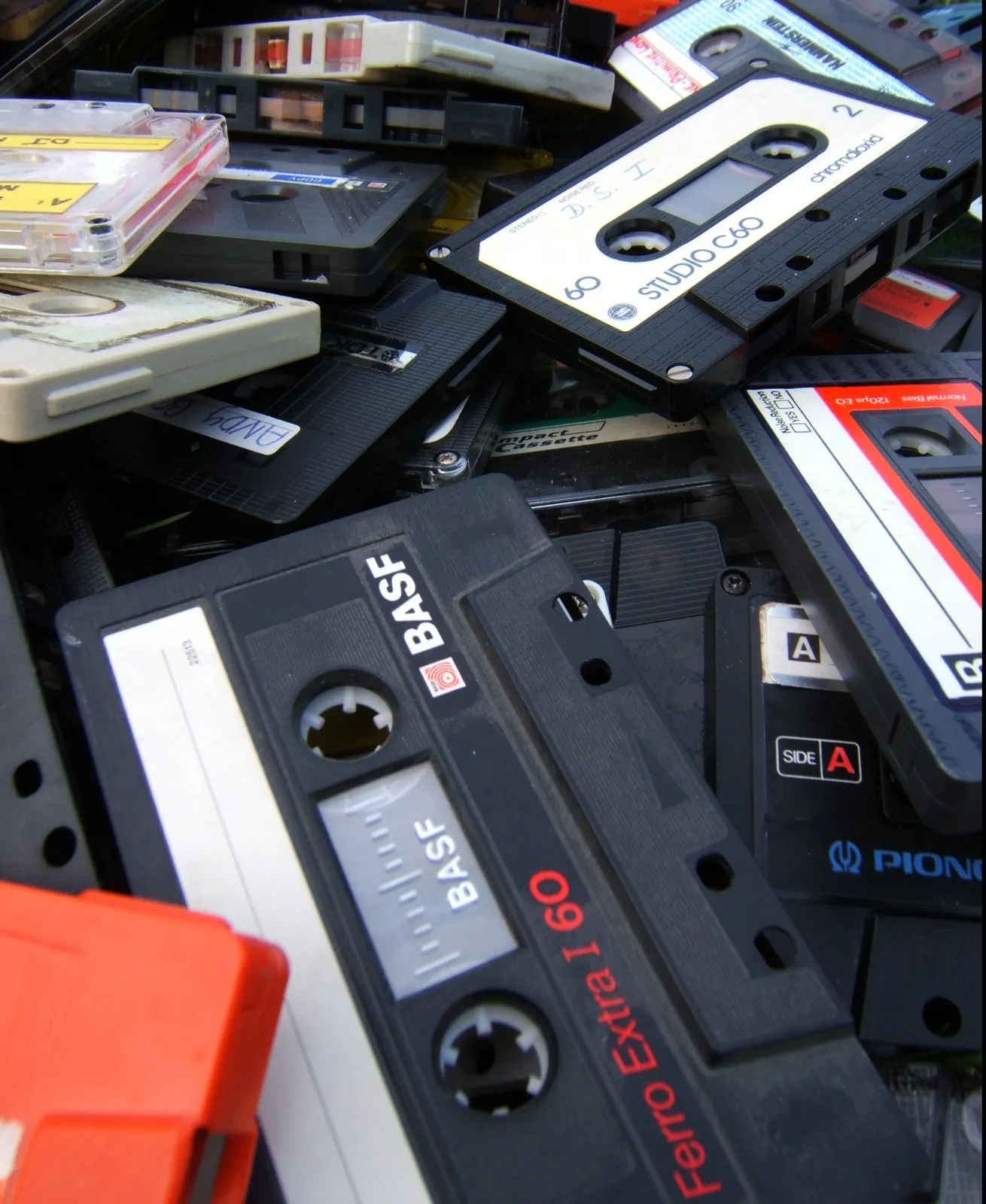
Here the honest objection has to be admitted, because not all repetition is intimacy. Theodor Adorno warned, in his essay on the “regression of listening”, that the culture industry uses repetition to manufacture mere recognition — to breed a passive listener who can only respond to what they have already been fed. A streaming “On Repeat” playlist, paired with a quarter of all tracks skipped in five seconds, can look less like devotion than like a dopamine loop the platform has learned to farm. So a line has to be drawn, and it is a real one: between a song that becomes yours and a song that is fed back to you because the machine knows you will take it. The difference is authorship. The replay you choose — the record worn into a groove, the cassette with no skip button, the private mental loop you cannot stop on a hard day — is an act of possession; the replay served to you is an act of capture.
This is why re-listening, freely chosen, is not the absence of curiosity but its deepest form. A first listen is reconnaissance; somewhere around the tenth, the dopamine has migrated forward into the anticipation, your throat tightens a half-second before the drop because your body now knows its shape, and the song stops being information and starts being yours. The catalogue offers everything and therefore nothing in particular. The song you have worn down is the one that has crossed from the outside world into the self — indistinguishable, by then, from memory.
Sources
- Diana Deutsch, the speech-to-song illusion (1995) — Wikipedia; Deutsch, Henthorn & Lapidis (2011), Journal of the Acoustical Society of America — PDF.
- Salimpoor, Benovoy, Larcher, Dagher & Zatorre (2011), “Anatomically distinct dopamine release during anticipation and experience of peak emotion to music”, Nature Neuroscience — PubMed · Nature; Salimpoor et al. (2013), reward-value prediction — ScienceDaily.
- Vuust & Witek on prediction and musical pleasure — Frontiers in Psychology.
- Elizabeth Hellmuth Margulis, On Repeat: How Music Plays the Mind (Oxford University Press, 2014) — OUP; “repeatability is how songs come to be the property of a group” — University of Arkansas.
- Kelly Jakubowski, earworm study (Goldsmiths) — Goldsmiths.
- Skip behaviour (Montecchio, Roy & Pachet, 2020), PLoS ONE — doi.org/10.1371/journal.pone.0239418; US vinyl in 2024 — RIAA.
- Theodor Adorno, “On the Fetish-Character in Music and the Regression of Listening” (1938).
Continue reading
- Against the algorithm: discovering music slowly — the counterpart: the slow way in, against the novelty engine.
- The album as one sustained argument — what in-order, repeated listening grants that the skip cannot.
- Melancholic songs, emotion and memory — how a re-heard song sediments memory until it is indistinguishable from the self.
- aus: what survives when the recording is gone — a composer who lost his recordings and went looking for the time inside them instead.