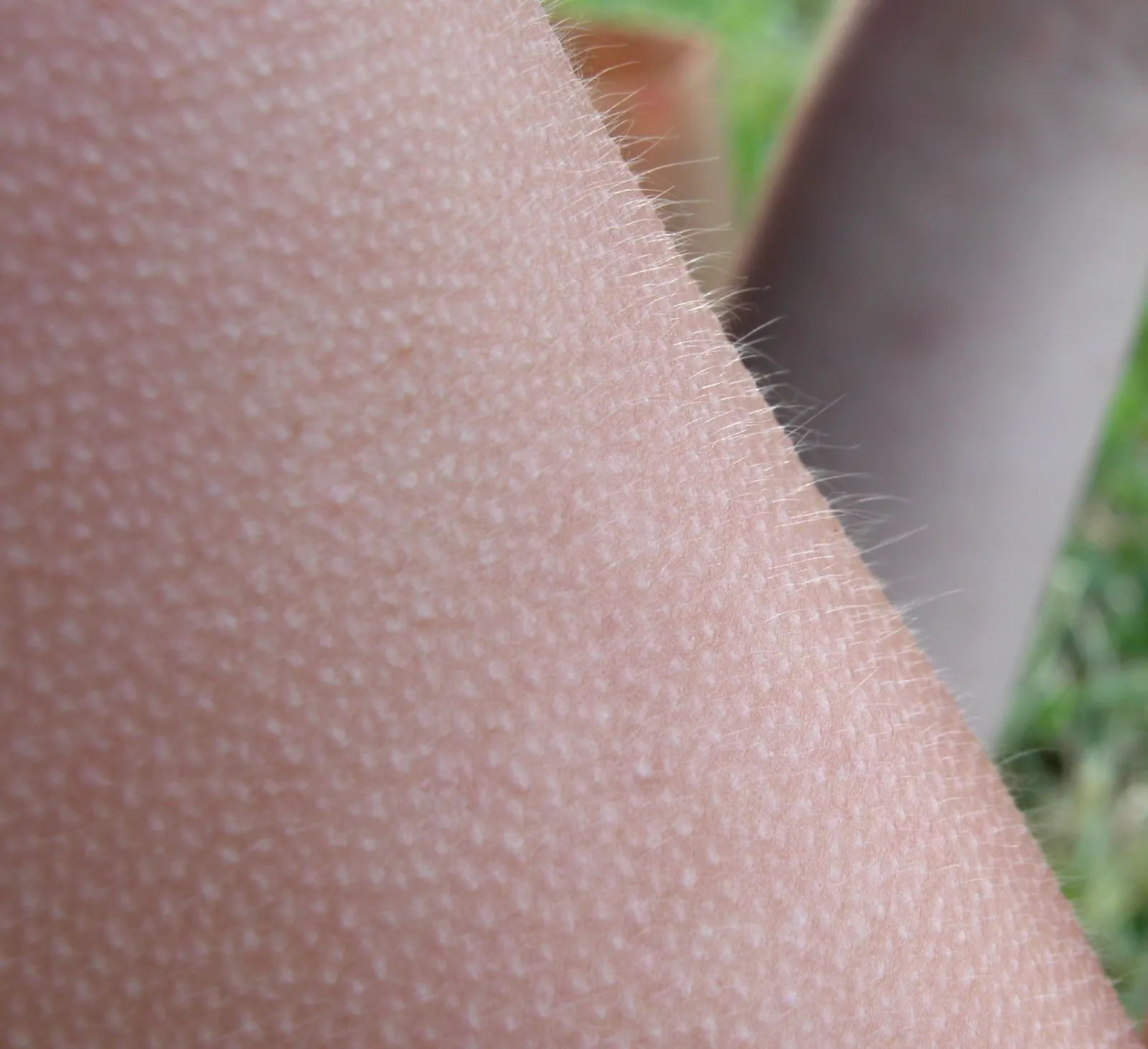
It usually arrives without warning. A slow crescendo gathers, a voice enters a register it has been avoiding, a harmony turns somewhere unexpected — and the skin on your forearms tightens into gooseflesh, a cool wave runs up the back of the neck, and for two or three seconds a piece of music is happening to your body as plainly as weather. Musicians call it frisson; the research literature calls it chills. It is one of the very few aesthetic emotions with a visible signature. You cannot watch someone’s nostalgia. You can watch their arm.
That visibility has made chills one of the most closely studied events in music psychology. A shiver can be time-stamped, which means it can be aligned — against the bar of the score where it happened, against skin conductance, against what the brain’s reward system was doing at that exact moment. Out of that alignment has come a small, unusually solid body of knowledge about what happens when sound briefly takes over the surface of the body.
A reflex borrowed from an older life
The mechanism itself is ancient and not musical at all. Piloerection — the tightening of tiny muscles at the base of each hair — is what a body does in cold, and what many mammals do in fear or confrontation, raising their coats to look larger or trap warmth. Nothing about a string section requires it. Music appears to have found a back door into a very old alarm-and-thermoregulation system, and the experience we prize at concerts is that system firing in a context where nothing is cold and nothing is dangerous.
This is worth sitting with, because it frames the real question. The puzzle of musical chills is not why skin can do this — skin has always done this — but why organised sound, an entirely abstract stimulus, is granted access to a reflex that evolution built for winter and wolves.
The chemistry of the wait
Part of the answer runs through the reward system. In a landmark 2011 study in Nature Neuroscience, Valorie Salimpoor, Robert Zatorre and colleagues used chills precisely because they can be timed: scanning listeners during self-chosen peak musical moments, they found endogenous dopamine release in the striatum at moments of peak emotion — and a division of labour inside it, with the caudate more engaged during the build-up and the nucleus accumbens at the peak itself. The wait, in other words, has its own chemistry. We have written about that two-stage architecture at greater length in our essay on re-listening, because it explains why a chill can survive a hundred repetitions of the same track: knowing the passage is coming does not defuse it. Anticipation is not the enemy of the shiver; it is half of it.
For years that finding was correlational — dopamine was present at the scene, but not convicted. A 2019 study in PNAS led by Laura Ferreri closed the gap with unusual directness: participants listened to music after receiving either a dopamine precursor (levodopa), a dopamine antagonist (risperidone), or a placebo, in a double-blind design. The two drugs pulled the experience in opposite directions — the precursor deepened reported pleasure and the motivation to keep listening, the antagonist flattened both. Musical pleasure is not merely accompanied by dopamine. It can be turned up and down with it.
Chills have an address in the score
A chill also has a location. In 2018, Scott Bannister and Tuomas Eerola took pieces known to produce chills, identified the exact passages where listeners reported them, and then quietly removed those passages. It was the first study to manipulate the music itself rather than merely correlate with it, and the result is worth stating precisely, because it is more interesting than the headline. The effect on how often chills arrived was real but modest: every piece produced fewer of them once its passage was gone, though the overall difference was only marginally significant and no single piece reached significance on its own. The physiological picture was sharper. Within the unedited music, skin conductance and continuous intensity ratings both ran significantly higher at the chills passages than at control passages matched either for musical structure or for acoustic profile. The shiver was not spread evenly through the piece, as it might be if chills were a free-floating property of mood or mindset. It sat where the structure sat: in the swell, the entrance, the turn.
That experiment is a useful corrective to two popular stories at once. Chills are not simply “in the listener”, available anywhere given the right receptivity; and they are not mystically “in the music” either, since the same listener, in the same sitting, responds at one passage and not at the one beside it. They happen at the meeting point — a prepared nervous system encountering a particular architectural event.
The uncertainty economy
What kind of event? The best current answer involves expectation. A 2019 study in Current Biology by Vincent Cheung, Stefan Koelsch and colleagues modelled tens of thousands of chords from commercial pop songs and found that musical pleasure follows neither surprise alone nor confirmation alone. It moves nonlinearly with the relationship between two quantities: how uncertain the listener was about what would come next, and how surprising the arrival actually was. Pleasure peaked when confident expectations were elegantly overturned — or when, in the middle of genuine uncertainty, the music resolved into something unexpectedly clear. Amygdala, hippocampus and auditory cortex tracked this interplay.
Chills, on this reading, are the visible tip of prediction. The swell that raises your arm-hair is a passage where the music has spent thirty seconds teaching you exactly what must happen next — and then does it, or does something better. Readers of our piece on complex music will recognise the territory: the pleasure zone sits between the obvious and the chaotic, and chills are what it occasionally looks like from outside.
Partly a trait
Why does the same climax electrify one listener and leave their neighbour politely unmoved? In 2026, Giacomo Bignardi and colleagues published the first large genetic study of the question in PLOS Genetics, drawing on 15,606 genotyped participants in the Netherlands. Proneness to chills from art and music turned out to be partly heritable: up to 29% of the variation was explained by familial effects, with about a quarter of that attributable to common genetic variants. And the genetic influences on musical chills overlapped substantially with those on chills from visual art and poetry — a genetic correlation of about .58 — suggesting a broader, partly inherited aesthetic sensitivity rather than a quirk of hearing.
The editorial consequence is worth stating plainly. If the person beside you at a concert does not shiver where you shiver, they are not listening wrongly. Some of the difference between you was settled long before either of you heard the piece.
What a chill is not
It is tempting to treat chills as a merit badge — proof that the music is great or the listener deep. The research supports neither. Chills mark a particular kind of structural event meeting a particular kind of nervous system; profound listening often happens without any of it, in the dry-eyed, attentive state this magazine spends most of its pages defending. A shiver is punctuation, not the sentence.
But when it comes, it is worth noticing what it teaches: that listening is not contemplation at a distance. A body that raises its hair at a modulation is a body that has been keeping track of every bar — predicting, comparing, updating — whether or not you felt yourself doing the work.
Try it as you read this
Samuel Barber’s Adagio for Strings is one of the most reliable chill-producers in the concert repertoire, and it is worth hearing with the mechanism in mind. Notice how long the climb is allowed to take; how the highest, loudest moment is followed not by an answer but by silence; and what your skin does in that silence.
Sources
- Salimpoor, V. N., Benovoy, M., Larcher, K., Dagher, A., & Zatorre, R. J. (2011). Anatomically distinct dopamine release during anticipation and experience of peak emotion to music. Nature Neuroscience, 14(2), 257–262. nature.com.
- Bannister, S., & Eerola, T. (2018). Suppressing the chills: effects of musical manipulation on the chills response. Frontiers in Psychology, 9, 2046. frontiersin.org.
- Ferreri, L., Mas-Herrero, E., Zatorre, R. J., et al. (2019). Dopamine modulates the reward experiences elicited by music. PNAS, 116(9), 3793–3798. pnas.org.
- Cheung, V. K. M., Harrison, P. M. C., Meyer, L., Pearce, M. T., Haynes, J.-D., & Koelsch, S. (2019). Uncertainty and surprise jointly predict musical pleasure and amygdala, hippocampus, and auditory cortex activity. Current Biology, 29(23), 4084–4092. doi.org.
- Bignardi, G., Admiraal, D., Eising, E., & Fisher, S. E. (2026). Genetic underpinnings of chills from art and music. PLOS Genetics, 22(2), e1012002. journals.plos.org.
Continue reading
- On re-listening: how a song becomes yours — why anticipation, not surprise, carries so much of musical pleasure.
- Why complex music sharpens creative listening — the wider argument about prediction, uncertainty, and reward.
- Why live acoustic concerts move us — what changes when the swell happens in a room full of other bodies.