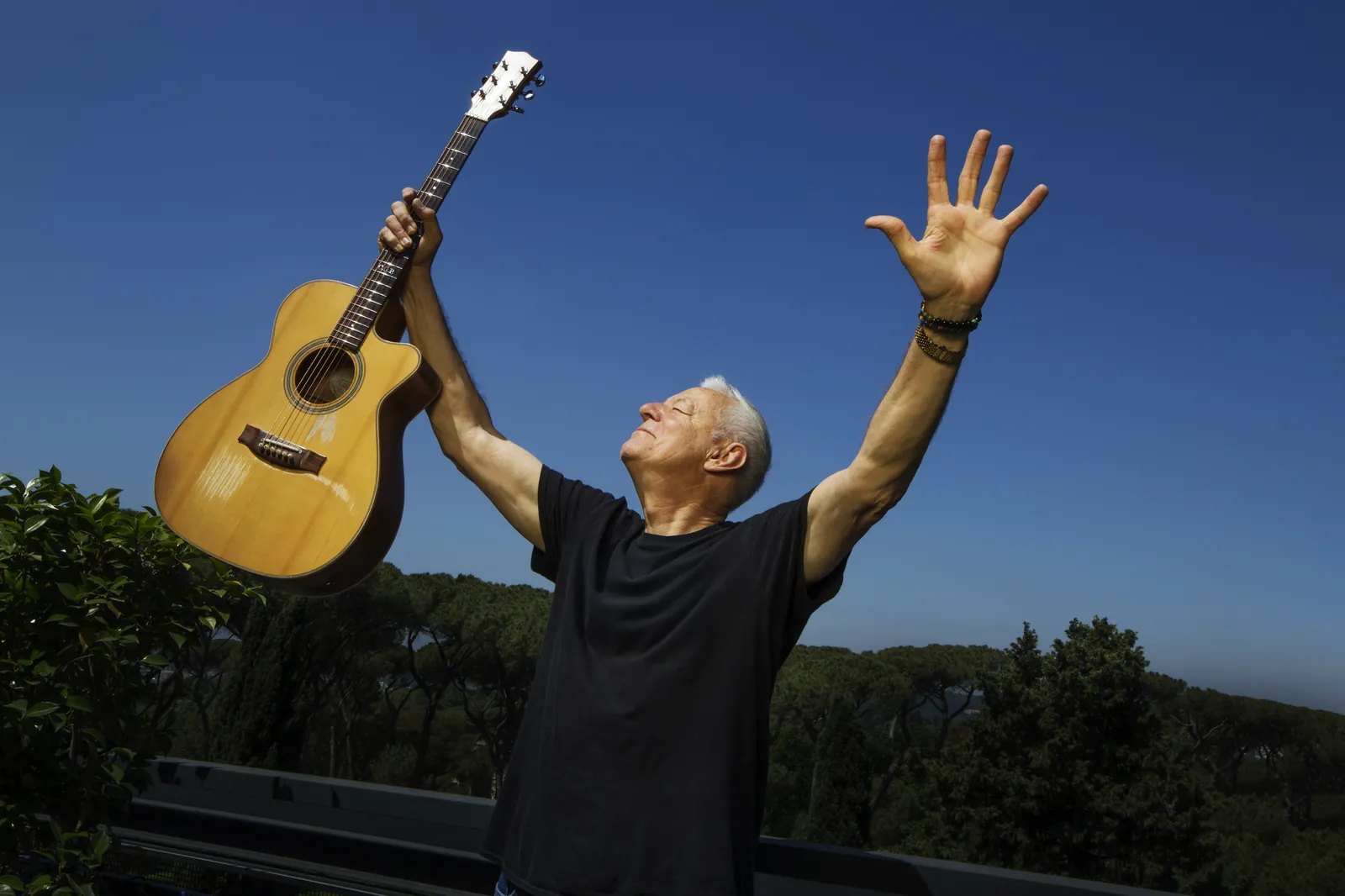
One man, one acoustic guitar, and the unmistakable sound of a whole band playing at once: that is the feat Tommy Emmanuel has spent a lifetime perfecting, and it is no illusion. A boy in rural Australia heard Chet Atkins on the radio and could not believe a single player was making all that sound; decades later Atkins had gone from his hero to his friend, and had given him a title he still wears after his name — CGP, Certified Guitar Player, an honour Atkins bestowed on only a handful of guitarists in his lifetime. On 27 July 2026, Emmanuel brought that lifetime of playing to the courtyard of the Adam Mickiewicz Library in Vilnius: open-air, and close enough to watch his right hand.
There are no loopers and no banks of pedals — one pedal on stage, a tuner, and, as he puts it, “the band I play with is in between my ears.” Melody, rhythm, bass and percussion all come from one instrument and ten fingers — that right thumb driving a bass line under everything while the hand above it sings. Behind the joy is a life that reads like a folk ballad: a childhood spent criss-crossing Australia in two station wagons, playing to paying audiences at around six; the loss of his father at eleven; years he has spoken of plainly as those of “a hopeless alcoholic and drug addict,” long since behind him; and, at seventy-one, a first solo album in a decade, Living in the Light, on which he finally steps out from behind the guitar to sing.
We sent Tommy a set of questions ahead of the Vilnius concert. He answered them the way he does most things — by picking up a recorder and simply talking. What follows is that conversation, lightly edited and in his own unhurried voice.
“The band between my ears”
You first heard Chet Atkins on the radio as a boy — it sounded to you like he was playing everything at once — and over the years he went from your hero to a real friend, and even gave you the title “Certified Guitar Player” that you still put after your name. Of all of it — the inspiration, the friendship, those three letters — what do you carry most consciously every time you sit down to play?
I try to honour the people that came before me when I play a show. I am trying to be as original as I can. I am trying to fit as much of my own material into my own show. But I talk about the people that have laid it all out for us. I try to be honourable to all the artists that came before me.
You’ve said the only pedal on your stage is a tuner, and that “the band I play with is in between my ears” — you’re the melody, the rhythm and the bass all at once, that right thumb driving the bass under everything. When you’re deep in a tune, does it feel like leading a little band, or has it all fused into one thing your hands do without you, as automatic as breathing?
I keep it very simple on stage when I play my solo shows because I don’t want to rely on electronic help like loopers and things like that. I can use them, but I choose not to. There are a lot of people out there playing now who use and depend on too much equipment. A lot of times when you travel, your equipment breaks down and all the fun you had when everything was working great goes away and you have got to scramble and try to make your show as good and as interesting as possible. I totally make sure that when I go out to play that my repertoire is bullet proof and that I can perform it at the best of my abilities and that everyone can have a good time.
“You can’t fool an audience”
You improvise big stretches of every show and have always refused to play it safe — you’ve often said you can’t fool an audience, so you don’t fool yourself. At this point you could easily lock in a set and coast. Why does keeping that risk alive still matter so much to you — what would be lost if you played it safe?
I love improvising but I also believe that people want to see you push yourself. They want to really see you out on a limb. I don’t want to play it too safe on stage. I like having fun with the audience but I am also very much in the moment on stage. So, I try very hard to go places and push myself to see what I can do on the night and that keeps me on the edge of it all and I like that.
Forget the guitar for a second — when a piece of music really reaches someone, what do you think is actually happening to them? And when you see a whole room go quiet, what do you feel is going on in there?
I try to use my instincts to know when to let the audience kind of sit back in their seat and just take in what I am doing. I try to soothe the audience. I try to make them feel like they are really in the music. This music is like their balm, it’s their medicine and I try to really give it to them at the right part of the show when I think they are ready. It’s not just about playing the guitar and trying to impress people; it’s about taking your audience to a place they haven’t been to for a while. That’s a good thing for both the artist and the audience.
“Surprise equals entertainment”
Two of the pieces you’ve sent us live at opposite ends: “Gdansk,” which you wrote in that Polish port with the ships and the harbour in mind, all calm and flowing — and “Tall Fiddler,” a flat-out sprint. How do you switch between being that still and that fierce, sometimes only minutes apart on stage? Does it take anything out of you, or is the contrast the fun of it?
It makes no difference to me whether I play fast or fierce or gentle. I can fly my kite and I can switch moods any time I want. But it’s two pieces that somehow just seem to fit together because they are in the same tuning. I wrote “Tall Fiddler” a long time ago and I wrote “Gdansk” about three years ago or something like that. They seem to go together, and I think the reason I chose to do it this way is that it’s a little unexpected. It can be a nice lift for the audience. It’s a way of constantly surprising the audience, and surprise equals entertainment.
“Tall Fiddler” is your tribute to Byron Berline, someone you’ve said you simply loved being around. But you honoured a fiddler on a guitar — making six strings answer an instrument that slides and sings where yours frets. How much of the tune is about Byron the man, and how much is you chasing the sound of his fiddle?
When I met Byron Berline, I was at a bluegrass festival in Kansas. I was struck by what a beautiful person he was and how everybody adored him. Then I saw him play and was like holy-moly this guy is a beautiful force of nature. So, we got to know each other over the years and he was very encouraging to me. Because, in the early days here in America I couldn’t get on bluegrass festivals because people didn’t think I was a bluegrass artist. And really, it’s just a title, it’s a style of music. I feel just as at home playing bluegrass as I do playing rock and roll or jazz or funk or blues, it doesn’t matter to me. It’s just music and I try to not let titles box me in. I had never written anything that was in a kind of fiddle style. And if you think about typical fiddle tunes in bluegrass there is a recurring theme. It comes around and it comes around and then there is a bridge and there are clever bits and sometimes there is a key change, but not so often. It’s just yet another way to give your audience something that slowly builds into a frenzy and when you hit the last chord and bang the lights go black - then the audience screams. It’s all part of being an entertainer and that’s about all I can tell you about that!
“Music comes to us when we need it”
There’s an old saying that music can change the world — not by force, but because it can change the way a person thinks and feels, and reach somewhere deeper than words ever get. After a lifetime of playing to people, do you believe that? Have you ever felt a tune genuinely change someone in front of you — or change you?
Definitely. Some certain songs we only have to hear them and we feel emotions immediately. Because that music is reaching something deep inside us that might be something we don’t always think about because it’s emotional. Because we want to be happy and maybe that song is about a part of our lives that might be painful for us. But I believe that music is like a magic gift to us and it comes to us when we need it. Sometimes in a show, I will purposely play something so simple but that’s that part of the show where the audience will say to themselves, this is actually what I came to hear. Not all the fireworks. I want to hear the soul. I want to feel the warmth in life right now and you can get that through music. When I first started playing “Somewhere Over The Rainbow” every time I played it, I felt I got a little better and I moved forward in my ideas playing the song. But I realised how beautiful that song was and how people needed to hear it, so that’s a good thing.
On Living in the Light — your first solo album in a decade — you step out from behind the guitar and actually sing on several tracks, including “Black and White to Color,” a song you’ve described as life turning a corner and changing colour, “kind of like Dorothy in The Wizard of Oz.” After saying so much through the guitar over the years, what made this the record where you finally wanted real words and your own voice?
When I went in to make “Living In the Light” I had only a very short time to make it. I recorded it and mixed it the whole thing in only 4 days. There were a couple of songs that I really loved doing, one of them was “Maxine” and the other one “Ready For The Times To Get Better” they just tell stories. And that’s how I feel – I’m not really a singer, I’m a story teller. I just wanted to do something different. I have no fear about that. I never said I was a good singer, I’m not. But I can sing a song and tell you a story. I hope that if the story and the song is good enough that you will really enjoy it. That’s how I think about it.
You’ve said music can’t be forced — that it has to come to you and flow through you. When a melody actually arrives for you these days, where are you — on the guitar, in the shower, half-asleep? Do you go looking for them, or just stay ready and let them turn up?
These days because my life is so busy, sometimes songs come to me when I get into the hall and get all my equipment in and then I go to the dressing room and I get my guitar out and start playing. Sometimes an idea will come to me then. Sometimes I also have ideas that will stay with me for years and I can return to them, and I can see if I can finish them. There is never one way to write a song. A composer is always waiting for something to happen that he can write about. The things that happen to you, people you meet, the experiences you have they create emotion and images in your mind and inside you. You are always hoping for something to happen that’s for sure.

“It sounds like my voice”
You’ve played Australian-made Maton guitars your whole career, when you could have your pick of any instrument in the world. Beyond loyalty to home, is there something in the actual sound of that guitar — its brightness, its woods — that you’d call Australian, that you couldn’t get anywhere else?
I play Maton guitars and I tour with them and record with them - I enjoy them so much. And I’ve been doing that since 1961; that is when I got my first Maton guitar. Yes, I am a loyal Australian and I like playing Australian made instruments, but I have many other guitars that I love. But I’ve found that there aren’t any other guitars out there that have a pickup and microphone system in them that even compare in any way to a Maton guitar. I can do so much with the sound of the guitar the sound of the pick-up and microphone. I can create all sorts of sound with that. And they just sound like my voice when I play them. When I play a Maton guitar I feel like I am home. As far as my choice of a guitar, I believe that is up to you. You have to find the guitar that you can’t put down, that you want to play all the time. That’s the best guitar for you. And it doesn’t matter where it’s from, how much it costs – that stuff doesn’t matter. If you find a guitar that you can do anything you want on it, then that’s the guitar for you.
You’ve been very open about the years when, in your own words, you were “a hopeless alcoholic and drug addict,” and about getting sober. So much of what you do on stage is improvised, with nowhere to hide. Did getting sober change the way you play — were you braver, or more reckless, back then, and which do you trust more now?
All I can tell you is that I’ve been sober a long time. I’m extremely well and loving my life. Also, I think even in the midst of my addictions, I was still giving 110% on stage, always trying to play my best and always trying to be there for the people even with all my struggles. But I don’t struggle anymore and I am so happy. I just let go and stopped fooling myself that I am in charge. I’m not. I show up and do the best that I can and try to take care of my body and my mind so that tomorrow I can do it all again.
“We knew what we wanted to do”
Your father sold the house, packed the family into two station wagons and put you all on the road across Australia — you were playing rhythm guitar for paying audiences at around six. Most kids that age are learning to read. Looking back, what did that childhood on the road give you that a settled one couldn’t — and what did it cost?
I didn’t know that life was hard, because we never had anything anyway. We discovered that we were musical and we wanted to play and we wanted to play as a family. The two little ones didn’t play music but the four of us did. That was me, the youngest, then my brother Phil, my sister Virginia and my brother Chris. And so, we didn’t know we were having a hard time at all. We were oblivious to that. We were travelling around Australia seeing the place, playing shows from time to time. But we never made much money, we were always broke and people were always helping us. From an adult point of view it would have been a hard life especially for mum and dad. You know, everything in life comes at a price. I can’t sit here today and say that I wish we could have done it like that or I wish we were rich. I’m sorry but it doesn’t work like that. We had the life that we had, and we knew what we wanted to do. I feel pretty blessed that’s for sure.
Your father died in 1966, when you were eleven — the man who’d built that whole travelling life around the band. How did losing him change what the guitar meant to you? Did it become a comfort, a duty, a way of staying close to him?
I loved my dad so much and tried so hard to get close to him. But he had heart disease and we kind of knew that he wouldn’t be around for a long time. One night he had a massive heart attack and he was gone. My mother said a couple of days later, “What do you want to do? We can stay here and you can go to school here, and we can have a normal life. Or we can look for a travelling show and we can go back on the road.” And we all agreed that we wanted to go back on the road and so that’s what we did. But it was different without dad, because dad did so much. But my eldest brother Chris became the father figure to us younger ones and we all clung together and kept travelling until we really had to stop and go to normal schools. The government saw what we were doing. They told my mother “These children have to have a normal life and go to school and have a home” – so they forced us off the road. I ran away from school when I was 15 because I knew what I wanted to do. And here I am talking to you, phone in my hand looking at another screen 60 years later and loving my life.
Do you ever think about how a tune you play for three minutes might stay lodged in someone for years — hummed on a walk, tied to a night they never quite forget? Does knowing music can reach that deep and stay there change how you play a single song?
I think it’s a beautiful thing that our brain takes in songs that we really love and then we can kind of play the song from our brain, it’s a beautiful thing. Music is our companion, it’s our friend, it’s our place of comfort and it’s our place for fun and joy too. It blows my mind that I can arrive in a country like China and there would be guys standing at the airport playing my songs. And I couldn’t believe it. It’s truly a magical thing. Music brings people together.
Music is our companion, it’s our friend, it’s our place of comfort and it’s our place for fun and joy too.
“Seventy-one is just a number”
You turned seventy-one this spring and you’re still out touring Living in the Light, and you’ve often said the whole point is simply to have fun — that if you’re having fun, the audience is too. But what you do is physically hard — the percussion on the body, the harmonics, that relentless thumb. How do you keep it joyful rather than just disciplined, now that the body asks more of you than it used to?
My body is asking more of me. I am afraid that some of the things I used to do I can’t do anymore. And I have to accept that – growing old is not for sissies that’s for sure! But 71 to me is just a number. I am not really worried about my failing health or whatever. I’ve got a bit of arthritis in my body and I’ve got torn muscles in my back. I’ve got a bit of the normal ageing stuff going on but I can’t really complain because, I’ve given it everything I’ve got all my life. It’s a wonder I’ve lived this long. It’s a state of mind really. When people say to me, “What happens if something happens to your hands? What happens if there is an accident and you can’t ever use your hands again?” I just say well I will find a way of playing with my feet. I will find a way to do something, to make a noise and to make music and try to give people a good time.
On 27 July you’re playing the library courtyard here in Vilnius — small, open-air, close. When people are near enough to actually watch your right hand, all the percussion and harmonics stop being magic tricks and become something they can see. Does playing that close change anything for you — do you lean into the show, or just play the tunes and let them watch?
I am really thrilled to be coming back to Vilnius, because I have such great memories of being there with my band back in 2011. The closer I can get to the audience for me, the better. I want to be right on top of you. I want to see your eyes. I want to see what you are going through as I am playing. I want to make a relationship with you through the music and I want to give you the best time that I possibly can.
I am so looking forward to coming back to see you on July 27 – see you then.
Listen
Official site: tommyemmanuel.com
Photographs: Luciano Viti and Simone Cecchetti, courtesy of the artist. Interview arranged with the Christopher Summer Festival, Vilnius.
Continue reading
- José González: the lab and the nylon string — another guitarist who builds whole rooms out of one instrument and a great deal of patience.
- Why live acoustic concerts move us so deeply — what actually happens when a room is close enough to hear the wood, not the amplification.
- Music and healing: what the evidence actually shows — the balm Emmanuel describes, and what research can and cannot claim for it.