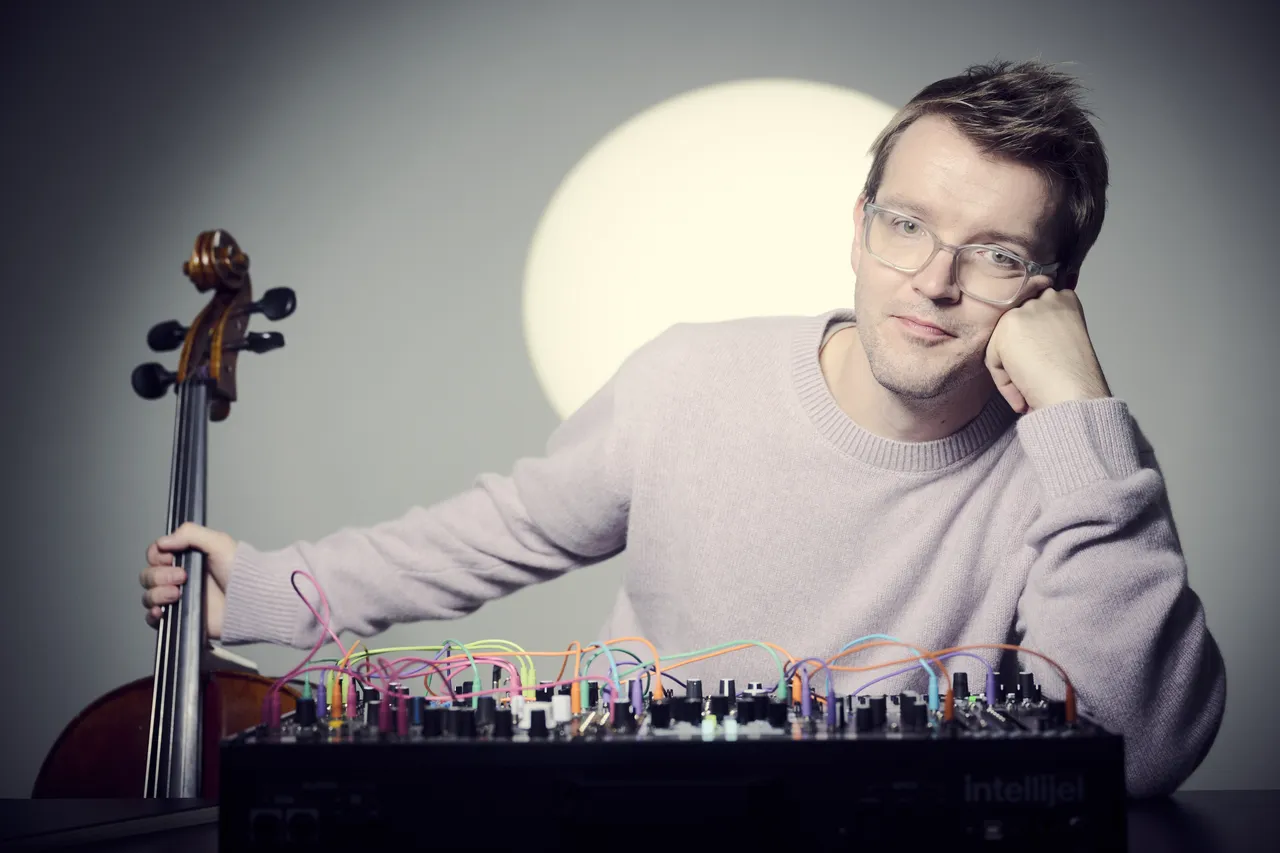
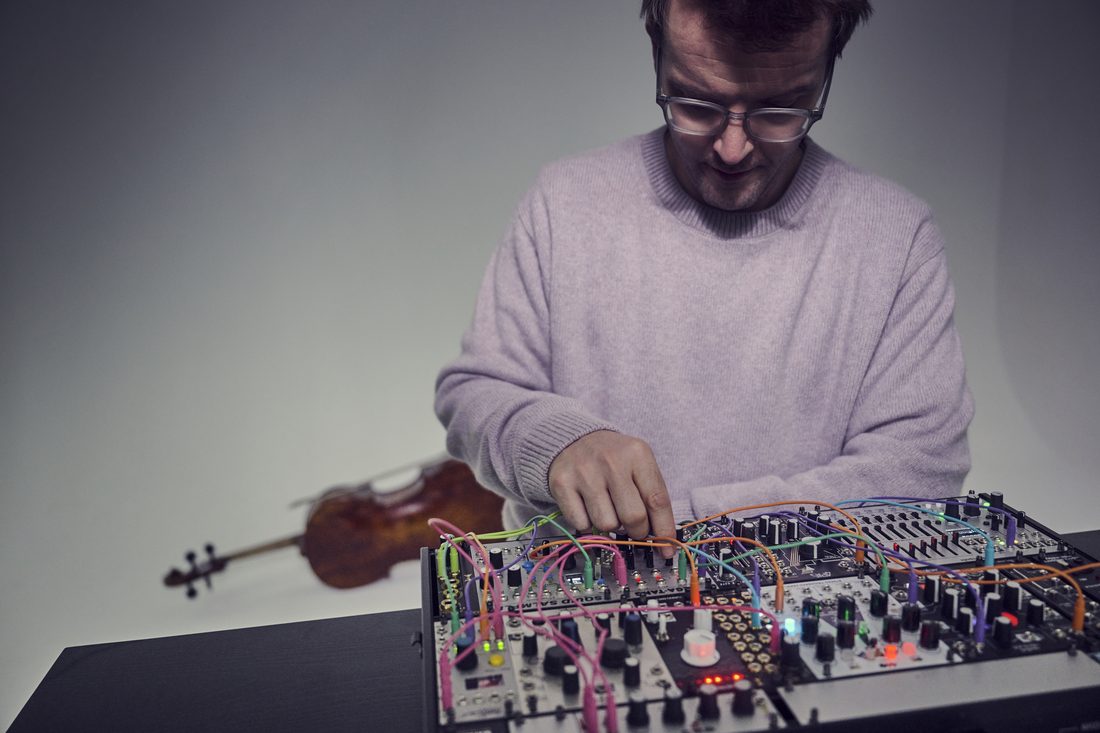
The cello, Peter Gregson says, is “a fabulous impersonator” — a single instrument that can be made to sound like a choir, a flute, a guitar, “all manner of things.” It is a fitting motto for his work. On his self-titled record he set himself a discipline that sounds like a constraint and turns out to be a freedom: build everything from the cello alone, feeding one instrument through a modular rig so that every electronic texture is, at root, still a bowed string.
Gregson is a British cellist and composer who has recorded for Deutsche Grammophon and, most recently, Decca. In 2018 Deutsche Grammophon invited him into its Recomposed series to reimagine Bach’s Cello Suites — the summit of the instrument’s repertoire — which he rebuilt at AIR Studios for his own cello, a five-cello ensemble and analogue synthesizers. He has also scored for the screen, from A Little Chaos to Bridgerton. That self-titled record, released on Decca in 2025, gathers pieces he calls “songs without words,” and answers to no one but himself. His answers reached us in writing, through his management, some weeks after we sent the questions; what follows is that exchange, lightly copy-edited for flow and nothing more.
”Music has to live and breathe in its own time”
Every body of work proposes a world — a place the listener is invited to stand in for a while. What world are you trying to make audible with your music, and how would you describe the air inside it?
I think music has to live and breathe in its own time — you can’t cynically be trying to predict the future, or dwell in the past. So I hope the air inside my music is alive and in the present.
Your music asks for patience in an age engineered for the opposite. Is that slowness an aesthetic preference, or has it become something closer to a quiet act of resistance?
I’ve been making my own music like this since 2006, releasing since 2008 — so, broadly speaking, a pre-social-media world, certainly pre-streaming. I think the aesthetic then was a sort of developed minimalism, and then it got locked into a time capsule because it was kind of accidentally quite successful with streaming. But I think it’s developing, and that’s great. Like I said earlier, I think music has to live and breathe in its own time, and speak of its own time — otherwise what is it doing? So I feel a shift coming, and I’m excited to see how it develops.
”The cello is a fabulous impersonator”
Your modular setup has no oscillators — only a cello going in, so every electronic sound is still, at root, the cello. What drew you to that discipline? Does confining yourself to a single voice feel like a limitation, or is it where the freedom actually lives?
The cello is a fabulous impersonator — just look at the Britten Cello Suites; he wrote so wonderfully for the cello, making it a choir, a flute, a guitar, all manner of things — so imaginative and so richly expressive. As cellists we are undoubtedly spoiled with the most incredible repertoire of music, but that doesn’t mean it should stop growing. The cello itself is a technological evolution — all instruments are — and the music has grown to provoke further developments.
I’ve been fascinated with electronics for a long time; I started integrating them when I was maybe fourteen years old? But it grew to a point where it always felt like they were added after, or in some way an afterthought. So, on my self-titled record, I wanted to create everything from the cello — and the modular approach really worked with that aesthetic.
Of all the voices you could have chosen, you chose the cello — and you’ve stayed. What is it about the cello specifically that lets you say what you need to say?
It’s a good question. I think everyone who plays an instrument would say the same thing — it feels like the extension of their voice.
You’ve made the point that instruments are themselves highly evolved technology — that classical music has always lived alongside machines. Where, for you, is the line between an instrument and a machine? Does the distinction even matter to the listener?
I don’t think it should matter. Tools are tools. It’s what you do with it that counts. There’s plenty of bland music for traditional classical instruments, and plenty of deeply emotive music for electronics.
”Songs without words”
Your most recent album has been described as “songs without words.” What can a wordless song say that words would only get in the way of? When language stops, what begins?
I think the beauty of “songs without words” is that it isn’t telling you what to feel or what to think, so it’s a wonderful way to present melodically led music — structured in a way that feels approachable and accessible, but with the room to inhabit the listener’s own world. If you’re feeling happy, you find the optimism; if you’re feeling down, you hear the darker side. It’s what keeps instrumental music really fresh and alive for me, at least.
Music plainly moves people — but the mechanism is mysterious. When a passage of cello reaches someone and something in them shifts, what do you think is actually happening?
I think it’s so deeply rooted — music really does “strike a nerve.” Like a lot of things, if we’re open to it, the connection is available, you know? Specifically with the cello, it occupies a very natural, human range of tones, so it does feel very natural to us — it fits the same sort of range as the human voice.
When a listener is moved to tears by a piece, whose feeling is that — yours, theirs, or the music’s own? Can a composer intend an emotion, or only build the room in which one might happen?
I think my music has my emotion in it, but I’m trying to create a space for the audience to have their feelings, not embody mine.
”One of the few sacred spaces where listening is still alive”
Imagine the thing simply gone — not just yours, but all of it. What do you think a world without music would actually lose? What would become unsayable that we can say now?
I think music keeps the art of listening alive. We’re increasingly in a shouting, sharing, talking, broadcasting world — everyone has an opinion that is equally and easily sharable — but nobody seems to know how to listen. I think music is one of the few sacred spaces where listening is still alive, and it is essential we keep that. That’s why music education for young children is so important — not so we have a world full of little cellists and oboists or whatever, but so they learn to listen, learn to be inside something bigger than themselves, and learn that you don’t need to be the loudest voice to be important.
We’re increasingly in a shouting, sharing, talking, broadcasting world — everyone has an opinion that is equally and easily sharable — but nobody seems to know how to listen.
Listeners often live with a piece in ways the composer never sees — through grief, sleeplessness, a hard year, a turning point. What have people told you about where your music has gone in their lives?
Well, yes, that’s true — but also, the composer is human too, and lives a life the audience never sees. There is one story that stands out and will live with me forever: someone wrote to me saying they’d played some of my music when their daughter was born, and it happened, totally wildly, to be the same day that my daughter was born — so we had this wonderful back and forth, and would wish each other’s child a happy birthday on the appropriate day. It goes the other way, too, where music is used at the end of life as a pacifier. These are really personal moments and stories I feel bound not to share, as people really do find a peace and connection in music that goes somewhere toward a confessional, somehow — it’s hard to describe.
Some music is made to comfort; some to disturb; some refuses to choose. What do you feel your music owes the person on the other end — consolation, honesty, company, something else?
My music doesn’t owe anyone anything, in the same way the audience doesn’t owe me anything. Both have to meet each other where they are — like a date!
”Bach is still Bach”
To “recompose” the Bach Cello Suites is an act of both reverence and trespass. What did spending that long inside another composer’s three-hundred-year-old work teach you — about Bach, and about yourself? Where is the line between honouring a piece and changing it?
Interesting. First of all, no matter what you do and how far you push it, the DNA of Bach is resolute, and I’d suggest uniquely strong, in that structurally you can’t break it. Critics often said it was sacrilege, and they’re welcome to their opinion, but people forget that Bach and his contemporaries did exactly this as well. In fact a lot of composers have done it over the centuries — and you know what, Bach is still Bach. I think my Recomposed can quite happily live without it negatively impacting the good name of Bach, haha!
It taught me so much about structure and proportions in music — there’s a fascinating if heavy book called Gödel, Escher, Bach: An Eternal Golden Braid which talks to this — but however you isolate or expand a phrase, it demands a structure that is still stronger than anything you’d come up with otherwise. It’s also wild how he wrote some of the most gloriously simple-sounding music that is still technically challenging. It taught me that where Bach could express it all for solo cello, I used six. The Bach Suites stand as the foundation and the peak summit in the cellist’s repertoire, and living inside them for however long I was working on them was a glorious reminder every day — like waking up to a beautiful sunrise and sunset. It never actually gets old.
”The sounds of its life”
Scrapes, breath, the friction of bow on string, the body of the player — your work often keeps the sounds a cleaner production would erase. Why do you protect those imperfections? What do they carry that a flawless sound loses?
Because these are the sounds of its life. If you erase them, it’s a sort of Instagram-ification of music. Like, nobody has a kitchen as clean and perfectly set up as a cooking influencer, right? It’s entirely implausible, yet we all see it and feel bad about our own kitchens. Music is a messy, noisy thing — it’s expressive, not manicured — so I want to keep it in, to bring the listener as close as possible to what I hear and feel.
Machines can now generate convincing instrumental music in seconds. For an art form whose whole meaning seems bound up with breath, bow-pressure and human imperfection — do you see AI as a threat, a tool, or simply irrelevant to what you do?
AI isn’t a threat if your work is one where you’re sharing emotion and telling stories. AI can do some astonishing things, but it doesn’t have emotion or perspective. I think what we’re seeing at a massive scale is people yearning for that connection — look at Jay-Z at Yankee Stadium, look at the other mega-scale musical events going on around the world. OK, that isn’t directly relevant in my corner of the music industry, but I think we’re seeing people wanting to experience something that means something to them. I don’t think the data centres are going to be opening up the galleries for tickets so people can watch the computer crank out more algorithmic background music, let’s put it that way.
”Space in the cup”
In music built on patience, silence and space do real work. What does silence do that sound cannot? How do you decide when to stop playing?
You have to leave room for the music to breathe, and for the listener to have space too, to interpret it into their lives. It’s like a cup of coffee — you can’t fill the mug, because then it’ll spill when you take it to your chair. You need room for it, so you can bring it into your life and be comfortable with it. So I try to make music with space in the cup.
You’ve described searching for the right sound — sometimes before pitch or harmony even enter — which is almost the opposite of how composition is usually taught. So where does a piece actually begin for you: a texture, a feeling, an image, a problem?
I’m very drawn to sound and texture, but I don’t force these things. Sometimes a melody comes from noodling around on the cello, or piano, or a synth; and sometimes I find a sound that interests me — I’ve rather a lot of fun toys in my studio, from reverbs and delays to synthesizers and harmonizers, vocoders, all sorts of things. I don’t really subscribe to the idea that there is a right way or a wrong way to write a piece of music — it’s a very personal expression, and however that manifests is the right way.
You’ve described your most recent album as the closest you’ve come to the sound you actually hear inside. Can you describe that ideal sound — the one you’re always chasing but perhaps never fully reach?
The ideal sound, for me, is one I want to touch — like a large-format oil painting in an art gallery.
You’ve scored for screen — from A Little Chaos to Bridgerton — and you’ve also made albums that answer to no one but you. Does music behave differently when it serves someone else’s images than when it is the thing being looked at?
Writing music for screen, you’re joining someone else’s story and trying to help tell it. You’re, at best, the third most important part of the story: the cinematography, the script, the performances on screen — these are all further up the food chain, but we’re also the last thing to go on, so we join at a crucial and fraught time. It has taught me that music is, above all, about listening — and that the music needs to listen to the picture, somehow.
”A therapy for me”
If music vanished from your own life tomorrow, who would you be without it? What is the question you’re really trying to answer each time you sit down to make something?
My music is definitely a therapy for me. It’s an extension of myself, and it’s where I feel most comfortable being vulnerable. It then becomes a bit of a dance when talking about it — because surely “just listen to the music” is the answer — but I do also find that you don’t always know what a piece of music is about in the moment. It’s like a way to process your thoughts and feelings, and sometimes clarity comes months or years later.
We live in an era of infinite, near-disposable sound. When you finish a piece, what do you quietly hope outlives the moment?
Writing for a legacy is unwise, because you miss the present moment. You can only do what’s right in that moment and honestly reflects your feelings on the day it’s written. Anything else is artificial, and I think at a primal level we can all identify that.
How do you measure progress as a musician — if you measure it at all? Is “getting better” something you can feel, a metric you quietly track, or was improvement never really the point?
You can’t. It’s not something definable, like weight loss or muscle growth, or running faster. Spotify has given us a false “proof” in streaming figures, but some of the most impactful music for me is low-streaming. Does that mean it’s less successful? No — because it met me where I am and spoke to me.
Listen
Official site: petergregson.co.uk
Photographs: Meredith Truax, courtesy of Key Music Management.
Continue reading
- Why slow music reaches deeper — the physiology of tempo, and why a single unhurried line can hold a whole room.
- Silence in music: the pause is not emptiness — why the breath and the rest belong to the music, not against it.
- Sebastian Plano: Solo, and being alone with the cello — another cellist on stripping everything back to a single, unaccompanied line.