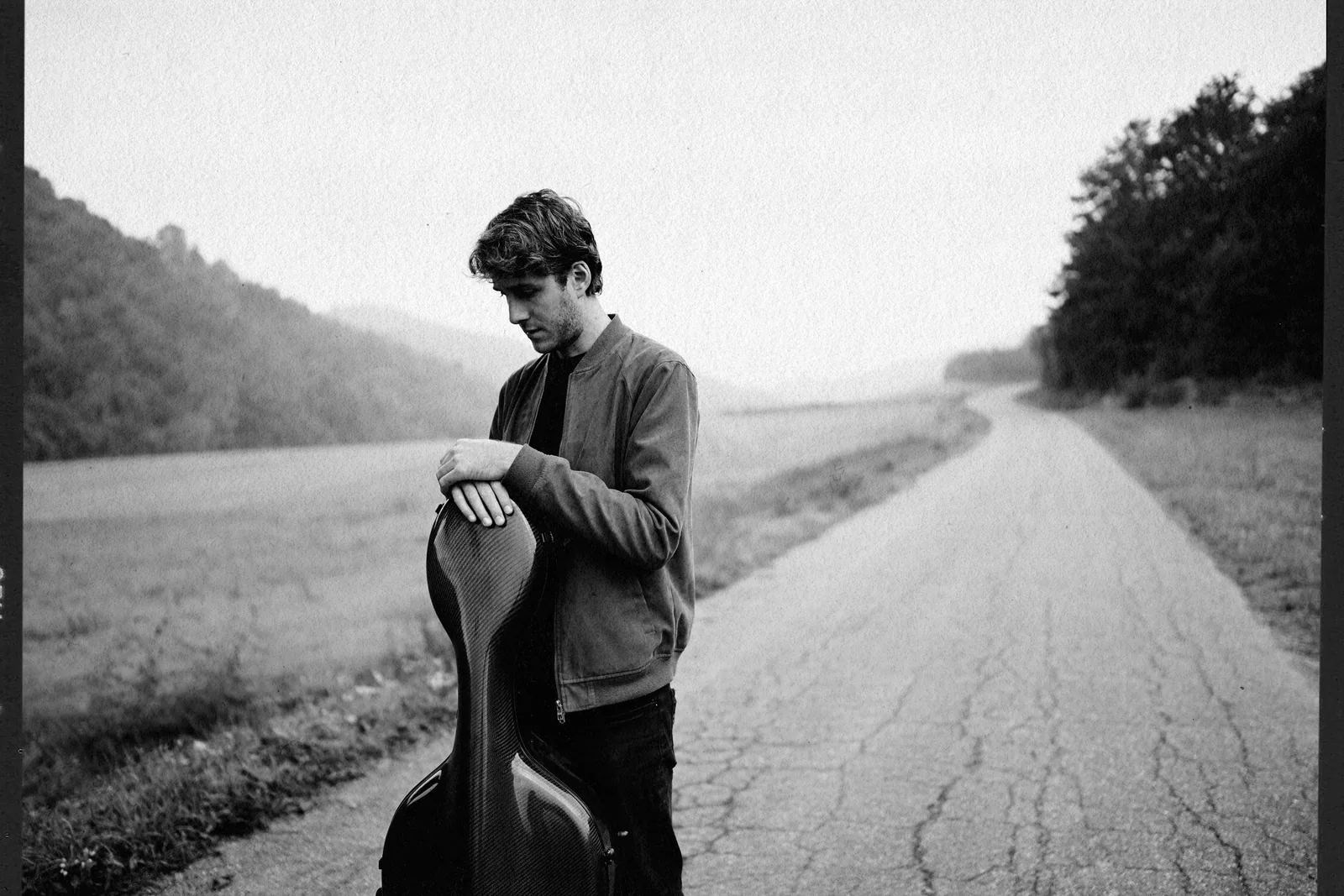
There is a photograph of Sebastian Plano standing on an empty country road, his cello case held against his chest, his head bowed, the asphalt thinning into mist behind him. It is the right image for Solo. After more than twenty years of carrying that instrument across the world — Rosario, Duino, Lisbon, Boston, San Francisco, Berlin, now northern Italy — the Argentine cellist and composer has finally made a record that puts down everything except the cello itself.
Plano, born in Rosario in 1985 and based in Berlin, is not a minimalist by temperament. His earlier albums layer cello, piano, electronics and percussion into something orchestral and cinematic; one of them, Verve, earned him a Grammy nomination. Solo, out on 26 June 2026, is the opposite gesture: his first album written and recorded entirely for unaccompanied cello, made over two years between his studios in Berlin and the Italian countryside. We sent him a set of considered questions and asked him to answer in his own time, in his own words. What follows is that conversation.
”You can’t hide anywhere”
You’ve described recording for solo cello as “like watching yourself in the mirror — you can’t hide anywhere”. After years of layering instruments and electronic textures, what did that mirror show you that the layers had been quietly covering?
The mirror showed me a lot. Unexpected aspects and challenges came along the way during the course of working on Solo. I had to completely change my approach to writing and recording music; it was definitely a step away from my comfort zone.
It’s striking how the mind can move in circles during creative processes, and I really experienced this with Solo. I normally write, perform, and record my music myself, and that was also the case here. But working with just a single instrument made the process both more focused and more challenging than I initially expected. My thoughts kept shifting from task to task; I was losing focus and, at times, perspective.
I truly believe the search for an artist’s voice never truly ends — it only evolves over time, and Solo is part of that evolution. The mirror was a reflection of what the record is made of: memory, contemplation, honesty, and vulnerability.
You’ve said that for years you moved through the world “with a cello strapped to my back”, but only with Solo did you finally journey “completely alone with it”. What is the difference between carrying the instrument and being alone with it — and why did it take until now?
For over twenty years of constant movement and living across different places, the cello has been my constant companion, always present, always carried with me — yet for a long time embedded within a larger musical world: layers of sound, production, and multiple voices interacting with each other.
With Solo, that changes. By “alone with it,” I mean stripping everything back to a single, unaccompanied line, with nothing to lean on except the instrument itself. It becomes a more exposed, immediate relationship with sound, gesture, and silence.
Your love of electronic music was sparked early by Vangelis, and your earlier records are full of electronic texture. Solo strips all of that away to the raw, unaccompanied instrument. Was leaving the machines behind a loss, a relief, or a dare to yourself?
It was purely a creative decision. It was challenging, but I didn’t approach it as a personal dare.
Honestly, I did miss the electronics — but working on such a focused project for a while gives you perspective, and it changes how you think about earlier ways of working.
”All there, mixed in my blood”
Rosario, Duino, Lisbon, Boston, San Francisco, Berlin, now northern Italy — a life measured in departures. Does Solo carry the accent of any one of those places, or has so much leaving sanded any single “home” out of the sound? Is someone who keeps leaving ever really “from” anywhere?
This is an interesting question, and to be completely honest, I have never felt like a foreigner in any of the places where I’ve lived. I still ask myself this question from time to time. I always felt I belonged to the place where I was, even if I didn’t speak the language at the beginning.
I have enormous curiosity for different cultures, but I don’t really believe in divisions — we all inhabit the same world, and it’s a very small one.
If Solo carries an accent, it would be an Argentinean one.
Both your parents played in Rosario’s symphony, and your grandfather was a tango composer and bandoneonist. The bandoneon and the cello both seem to breathe and ache in a similar register. Is there tango buried somewhere in how you shape a phrase — even when the music sounds nothing like tango?
Yes, it definitely is. Tango music and culture were an early influence for me — not only through listening to my grandpa’s music, but also through gradually shifting from traditional tango to the more modern approach of Astor Piazzolla’s music, which had a strong impact on me during my twenties.
All of those tango influences are very present in my music. It may not sound like tango, but it’s all there, mixed in my blood. Pieces like “Gone in Time” or “Returning Home” on Solo are good examples of this. If we go earlier, tracks like “All Given to Machinery” or “Living” from the record Impetus also live in that world.
I inherited my grandpa’s bandoneon. It’s there sleeping, waiting to be woken up…
You’ve said “Every Beginning” feels like it belongs to all places at once, and that it holds the moment of arrival. After so many arrivals in one life, what does arrival actually feel like to you now — still the old excitement, or something quieter?
It still feels just as exciting as it did in the beginning. It’s like moving through different chapters of your life, each one shaping you in new ways. It’s not only about the place itself, but also the culture, the people you meet, the food, and everything that surrounds it. All of this contributes to your growth as an artist, creating a rich and diverse environment for exploration.
Everything becomes part of the music — the breathing, the silence, and all the imperfections within it. I wanted the sound to feel close, so that the listener feels as if they are inside the room where I am recording it.
”Stories of movement and transformation”
Solo was written and recorded over two years between Berlin and northern Italy. That’s a long time to keep one record company. Did the music change shape as the place beneath it changed — could a phrase written in a Berlin winter survive an Italian summer, or did the move quietly rewrite it?
Yes, I was writing and recording the album between my two studios in Berlin and Italy, travelling by car with my cello and recording equipment. I remember waiting to cross the Swiss Alps to listen to the sketches I had.
The music didn’t really change because of those conditions — I chose them deliberately, as they are part of what the record is at its core: stories of movement and transformation. It enriched the entire process. I would write extensively in Berlin, and then go to the countryside in Italy, where I found it very inspiring to develop ideas, record, and let the process flow freely.
You’ve rebuilt entire albums that were lost to theft. Making something a second time is a strange fate — the second version knows things the first one couldn’t. What did losing the work, and remaking it, teach you about what was truly essential in it?
The loss of all the compositions and recordings I had for my record Verve was a very strong emotional setback. It was actually the final spark that made me relocate from San Francisco to Berlin, months after the incident happened.
Now, in retrospect, I am glad that this event happened. It gave me strength and vigour; the reconstruction process was so intense and beautiful, working late into the nights, where memories of old ideas would blend with new ideas and perspectives.
Who knows — maybe the earlier version will appear one day… Meanwhile, without that theft, I don’t think I would have got a Grammy nomination for Verve.
You let the bow noise and the breath stay in. For a player who came up through conservatories that train such sounds out, what made you decide those small frictions belonged — that the grain was the point, not the flaw?
Everything becomes part of the music — the breathing, the silence, and all the imperfections within it. I wanted the sound to feel close, so that the listener feels as if they are inside the room where I am recording it.
”It comes to belong to the listener”
When the last note of Solo fades, where do you hope a listener finds themselves standing?
Solo begins as my story, but I hope it ultimately comes to belong to the listener. By the final note, I want them to feel they have travelled through something personal of their own — a memory, a change, or simply a moment of stillness.
You made Solo largely alone. Is it a record meant to be heard alone too — and is there a particular kind of solitude in a listener you’d most want it to reach, the way it reached you while you were making it?
Music provides a strong sense of companionship. Solitude is part of my creative process, but it is also a space away from music that I need for reflection and mental clarity. For the listener, I don’t imagine a specific situation, but there is a certain kind of attention that allows the music to unfold more fully.
If you know who you are and what you want, what fulfils you, solitude doesn’t have to feel empty — it can feel grounded and complete.
And a lighter last one: in a life of so much leaving, is there one small object — not the cello — that has somehow made it onto every single move with you?
Yes, my mate.
Mate is a traditional South American drink, especially popular in Argentina. It is deeply social, and drinking mate is different from drinking coffee or tea; you often drink it for hours, refilling the same gourd. I have a wooden one that has been a companion along the way.
The cello is the instrument he carries; the mate is the small wooden thing that carries home. Between the two, Solo finds its register — a single line, played close enough that you can hear the breath, asking only the kind of attention that lets a private story become, for the length of a record, your own.
Listen
Official site: sebastianplano.com
Photograph: Paolo Barretta (@iamwinter).
Continue reading
- Why slow music reaches deeper — the physiology of tempo, and why a single unhurried line can hold a whole room.
- Silence in music: the pause is not emptiness — why the breath and the rest belong to the music, not against it.
- Cinematic acoustic pop: four artists — Agnes Obel and others who build cinematic scale from intimate, acoustic means.