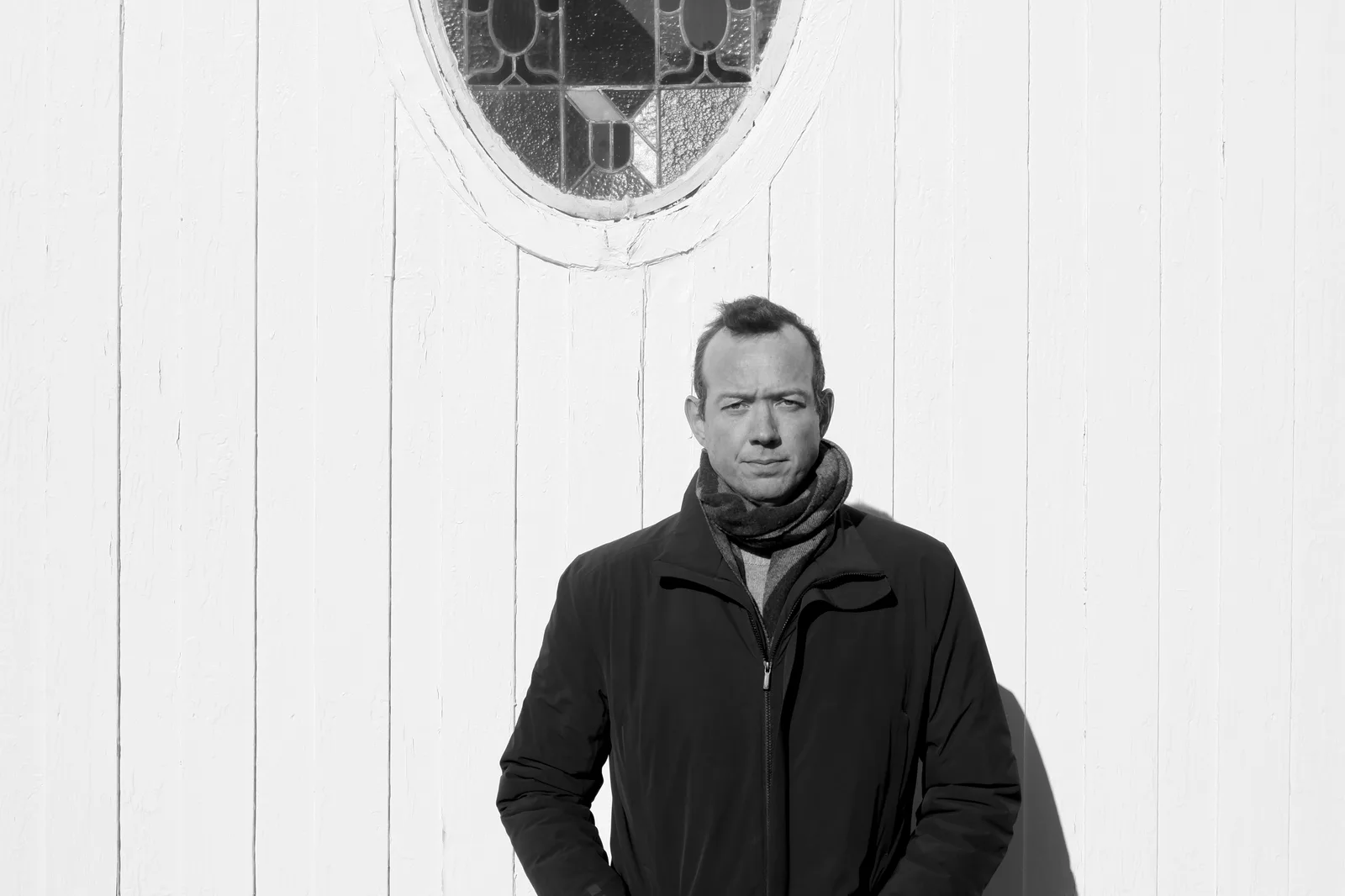
It is easy to file Jacob Collier under prodigy and consider the case closed. He is a seven-time Grammy winner with sixteen nominations through the 2026 ceremony. The Royal Academy of Music identifies him not simply as a singer-songwriter and multi-instrumentalist but as a producer and educator — a quiet but important addition, because educator is the word that tells you the actual project. His real subject has never been complexity for its own sake. His real subject is the people he is making the music with, which on a given night includes the audience. On 11 July 2026 that audience will be assembled at the Palace of the Grand Dukes of Lithuania in Vilnius, where he performs with Take 6 and the Lithuanian Chamber Orchestra, conducted by his mother, Suzie Collier. The Lithuanian context is unusual; the artistic logic is not.
To understand what is going to happen in that hall, it helps to read his recent work the right way. Djesse Vol. 4, the final instalment of a six-year, four-volume project, includes — according to Associated Press reporting and Collier’s own production notes — the recorded voices of more than a hundred thousand audience members, collected across the live tour. The Guardian described the album as a mind-melting genre-spanning culmination that moves between folk balladry, pop, doom metal, rap, samba, and audience-derived choral sound. That last phrase is the one worth holding. Collier did not record a choir; he composed with a touring audience. He is not making songs that an audience listens to. He is making songs that an audience helps build, then takes home as part of the recording.
A conductor of crowds
Anyone who has been to a Collier show in the last few years has watched the same small ritual. He holds up his hands and divides the room into sections by pitch. He sings a note, then assigns it. He sings another, then assigns it. He sings a third. Within about ninety seconds he has the room voicing a three- or four-note chord in choral parts — and within another minute, that chord moves, becomes unstable, resolves into something else. He records the result. Sometimes the result ends up on a record.
The technical word for what he is doing on stage is conducting. The emotional word is gathering. He is not testing whether strangers will perform on cue. He is showing them, by doing, that what they thought were their separate voices are actually capable of constructing a single shared object in real time. That construction does not require any of them to be a musician. It only requires them to listen to each other for two minutes.
Why this is not a stage trick
It is tempting to call the audience-choir moments a clever piece of showmanship. It is not. It rests on something the music-science literature has been quietly building for two decades.
A Royal Society Open Science study identified what its authors called an ice-breaker effect: people who sing together — even unfamiliar people, briefly — show measurably faster increases in social cohesion than people who share other comparable activities. Group vocalisation does something that group conversation does not. It synchronises breath, attention, and pitch perception, and it does so without the social drag of having to introduce yourself first. Collier’s stage practice operationalises that finding without naming it.
A famous Nature Neuroscience study, meanwhile, found that intensely pleasurable music activates the brain’s reward circuitry — including dopamine release — not just at peaks but during the anticipation of peaks. That is critical for understanding what an audience feels during one of his progressions. When a Collier chord is leaning into a resolution that has been delayed three bars longer than the ear expected, the body is already inside the reward arc. The arrival is the second pleasure; the wait is the first.
A live Collier performance is the closest thing in contemporary popular music to a temporary community built out of attention, breath, and harmonic tension — and then dismantled and taken home as memory.
That is what makes the work feel different from other virtuosic acts. The virtuosity is structural; what reaches the audience is participatory. Complexity, in his hands, becomes the vehicle for communion rather than its obstacle.
What Take 6 and a chamber orchestra add
The Vilnius programme is significant precisely because of who shares the stage. Take 6 are one of the most lineage-rich vocal ensembles in modern American music — a six-voice a cappella group whose harmonic literacy spans gospel, jazz, R&B, and contemporary classical influence. They have spent decades making the case that the human voice, in close harmony, is the most expressive instrument the species has ever invented. Pairing them with Collier is not novelty. It is two generations of close-harmony thinking in one room.
The Lithuanian Chamber Orchestra adds the third register. A chamber orchestra is small enough to keep its phrasing intimate, large enough to give a song an architecture of strings. Conducted by Suzie Collier — herself a violinist and educator, and Jacob’s primary musical influence — the orchestra is not the backdrop. It is the family context made audible.
For a Vilnius audience, the most accurate way to anticipate the evening is to expect three layered offers. The voice of one performer who has been called a generational ear. A six-voice ensemble whose harmonic depth has carried a tradition for thirty years. And a Lithuanian orchestra giving the room a national-language phrasing inside a globally scaled musical idiom. Few touring acts in 2026 are built this way.
The democratisation argument
If there is one editorial claim worth defending about Collier, it is this: he democratises musical complexity. He takes harmony, rhythm, micro-variation, and collaborative arrangement, and presents them as participatory rather than exclusionary. The educational dimension — his YouTube videos, his masterclasses, his patient explanations of why a chord with thirteen notes is not noise — extends the same gesture into the rest of the week. The concerts are not separate from the teaching. They are the practical exam.
That argument is supported by broader research, too. A 2023 meta-analysis of randomised studies on musicking found a small-to-moderate positive overall effect on emotion regulation, with the largest effects for participants who could choose the music they engaged with — that is, for self-selected, preference-aligned listening. Collier’s invitation to participate inside the music, rather than receive it from a stage, is the live-performance equivalent of that finding: people experience music more profoundly when they have agency inside it.
The deepest case for his work, then, is not that he knows more chords than other writers, although he does. It is that he treats a concert hall like a temporary community capable of doing more than applauding. That is rare on a stage of any size. At the Palace of the Grand Dukes, it will be rarer still — the room itself was built for civic gathering long before it was a concert hall, and the programme is, in a real sense, asking it to be one again.
How to listen on 11 July
Three orientations, then, for a Vilnius audience.
First: when he invites the room to sing, sing. The whole architecture of the work depends on it. The recording in your head of the night will be different depending on whether you were a voice inside the chord or an observer of it.
Second: listen for what the orchestra is doing under the harmony, not as accompaniment but as a parallel voice. The Lithuanian Chamber Orchestra is not there to support Collier; it is there to thicken the room.
Third: notice what Take 6 do with internal harmony when they sing across Collier’s arrangements. They are not blending in the way a backing choir blends. They are arguing with the harmony from inside it. That argument is part of why a song like In My Bones can sit on a single chord for a long time without ever sounding static.
A Collier concert is not a recital. It is a temporary construction project. On 11 July in Vilnius the construction project includes you. The most useful thing you can bring is not knowledge of his catalogue. It is the willingness to spend two hours treating your own voice as part of the orchestra.
Sources
- Royal Academy of Music — Jacob Collier profile, ram.ac.uk.
- Recording Academy — Jacob Collier artist page, grammy.com/artists/jacob-collier.
- Associated Press — coverage of Djesse Vol. 4 and audience-recording practice.
- The Guardian — Djesse Vol. 4 review, theguardian.com.
- Jacob Collier — official site and 2026 tour calendar, jacobcollier.com.
- Royal Society Open Science — “The ice-breaker effect: singing mediates fast social bonding” (Pearce et al., 2015), royalsocietypublishing.org.
- Nature Neuroscience — “Anatomically distinct dopamine release during anticipation and experience of peak emotion to music” (Salimpoor et al., 2011), nature.com.
- Music and emotion regulation — 2023 meta-analysis of randomised studies on musicking interventions.
- Hero photo: “Jacob Collier at the 2024 Positivus Festival” by Krists Luhaers, via Wikimedia Commons, CC BY 4.0. Cropped and resized for web display; no other alterations.
Continue reading
- Why complex music sharpens creative listening — the cognitive case for music that asks for more than passive attention.
- Why live acoustic concerts move us so deeply — what shared-room performance does that no recording can replicate.
- Why slow music reaches deeper than it seems — the physiology of a tempo that lets a room breathe together.