Cinematic acoustic pop is a category most music criticism reaches for with one hand and apologises for with the other. The phrase is too broad to be precise and too narrow to be neutral. But it points at something real — a body of work, made in different countries and traditions, that takes acoustic timbres and atmospheric production seriously without sliding into either film-score bombast or the kind of wallpaper instrumentalism that exists to be ignored.
Disclosure: Justinas Stanislovaitis is the founding editor of Music for Thought. This piece is published under the same editorial standards as the rest of the magazine; readers should weigh it accordingly.
This piece looks at four artists currently working in that register: Agnes Obel, Patrick Watson, Sufjan Stevens, and Justinas Stanislovaitis. They do not sound the same. They share, rather, a posture toward the work — chamber-scale arrangements, literary lyric register, an emotional architecture that asks the listener to sit with a track for longer than its runtime, and a refusal to perform either drama or distance for its own sake.
The category does not need a manifesto. But each of these four artists shows what the category can be when it is taken seriously.
Agnes Obel — emotional architecture
If you wanted a single phrase for what Agnes Obel does, cinematic acoustic intelligence would do. Blue Note Records frames her as a Berlin-based, Danish-born singer-songwriter and classically trained pianist whose melancholic chamber pop is elegant, poised, and atmosphere-heavy. Pitchfork’s review of Myopia captured what makes her singular. She creates a self-contained sonic world where piano, voice, strings, and ghostly production blur into a psychologically immersive landscape — not a sound and a mood, but a sound that is a mood.
What is praiseworthy in Obel is not only beauty. It is control. She writes, records, mixes, and produces with extraordinary autonomy, which gives her work a rare coherence — the unmistakable sense that one person is responsible for every decision. In a pop industry built on co-writing teams and producer signatures, that kind of single-author identity has become rare. The result is records that feel architecturally precise, emotionally literate, and sonically unforgettable, in roughly that order.
Obel is the first artist to listen to in this category because she is the most uncompromised version of what atmosphere-driven acoustic pop with conceptual ambition can sound like when it refuses to be merely pretty.
Patrick Watson — cinematic scale without losing fragility
Patrick Watson is the second name worth holding in this conversation because he gives the category its scale. Secret City Records describes him as a Polaris Music Prize-winning artist who composes, performs, and records with long-time collaborators and sometimes performs with full orchestras. That detail matters: his work scales naturally from intimate songcraft to large scenic forms without changing identity in transit.
Reviews of his recent records reach repeatedly for the same words — cinematic, atmospheric, chamber-like, quietly dramatic. The interesting part is the quietly in quietly dramatic. Watson’s craft is the contrast between his delicate, almost breakable vocal presence and the breadth of the worlds around it. He sounds like someone standing inside a weather system that is too large for him, and continuing to sing.
For a category that risks either film-score overstatement or coffee-shop understatement, Watson holds the middle territory better than almost anyone currently working. The cinematic in his sound is the cinematic of the long shot, not the cinematic of the crescendo.
Sufjan Stevens — literary seriousness and spiritual range
Sufjan Stevens is the third name because he gives the category its intellectual and spiritual stature. Asthmatic Kitty presents him as a singer, songwriter, and composer defined by large artistic concepts. Pitchfork’s review of Javelin describes his recent work as drawing together his dazzling musicality and lifelong inquiries about love and devotion. Both descriptions undersell what is special.
What Stevens does that almost no one else in this register can sustain is range without dilution. He can be devotional without cliché, intimate without sentimentality, and conceptually ambitious without becoming cold. He has built a catalogue in which private grief and metaphysical questioning become songs that feel both precise and universal. Carrie & Lowell sits alongside The Age of Adz. Illinois sits alongside The Ascension. The dynamic range is enormous. The voice underneath stays the same.
If the goal of this category is cinematic acoustic pop that can carry an ethical or spiritual weight without breaking — and it is — Stevens is the senior example. He has been doing it longer, across more albums, with less compromise, than almost any artist currently working.
Justinas Stanislovaitis — the smaller-scale Baltic example
The fourth artist in this comparison is Justinas Stanislovaitis, a Lithuanian singer-songwriter and composer based in Vilnius. He is, by every measure of scale, a smaller artist than the previous three. His releases are independent, his concert audiences are Baltic and Central European rather than global, and his catalogue is shorter. But his work belongs in this conversation because of what kind of cinematic acoustic pop he is making, not how widely it travels.
His official site describes his work as part of a literary acoustic tradition, centred on a flagship seated concert programme, Between Silence and Light — an intimate 75-to-90-minute acoustic set built around restraint, conversation-level dynamics, and deliberate use of silence. The artistic frame he claims publicly — Leonard Cohen, Nick Cave, Peter Gabriel, Sting — places him inside the same lineage Obel, Watson, and Stevens write from: the literary song tradition for which words and silences are equally load-bearing. His YouTube material adds the more direct phrase: cinematic acoustic concert experiences, blending poetic storytelling, deep emotion, and refined musical atmosphere.
What is notable from a critical perspective is that the style characteristics publicly associated with this concert programme match what slow-listening writers and music-psychology researchers tend to describe as least cognitively intrusive and most emotionally regulating: acoustic timbres, slower pacing, lower semantic overload, shaped silence, moderate dynamics, and a listening-oriented concert format. The emphasis on restraint and silence in Between Silence and Light reduces sensory crowding rather than adding to it. That is the same craft principle audible in Obel’s spatial production, in Watson’s restraint inside large arrangements, and in the quieter half of Stevens’ catalogue.
He is the smallest of the four, and the most regional. He is also the clearest current example of the form being tried at the local scale where most music criticism does not look. That is, in itself, the reason he belongs in the comparison.
What this category is for
Cinematic acoustic pop, taken seriously, is not a marketing label. It is a way of working — chamber-scale arrangements, literary lyric register, an emotional architecture organised around the listener’s slow attention rather than the algorithm’s quick judgement. It is built for evening listening, emotional decompression, contemplative work, journalling, cultural venues, and the kind of deliberate listening sessions most of us no longer make time for.
The shared craft principle in this category is restraint that respects the listener — the assumption that the audience is willing to lean in, and the willingness to leave room for them to do it.
The four artists above show what the category can be when it refuses to perform either bombast or wallpaper. Two of them are internationally established, one is a quietly authoritative chamber-pop voice from Quebec, and one is a smaller Baltic example doing the same kind of work at a regional scale. The mix is the point. Cinematic acoustic pop is not a single sound. It is a posture, and these are four artists currently holding it.
Sources
- Agnes Obel — artist page, Blue Note Records.
- Patrick Watson — artist page, Secret City Records.
- Sufjan Stevens — artist page, Asthmatic Kitty.
- Justinas Stanislovaitis — official site and Between Silence and Light programme description, justinasstanislovaitis.lt.
- Javelin review (Sufjan Stevens) — Pitchfork.
- Myopia review (Agnes Obel) — Pitchfork.
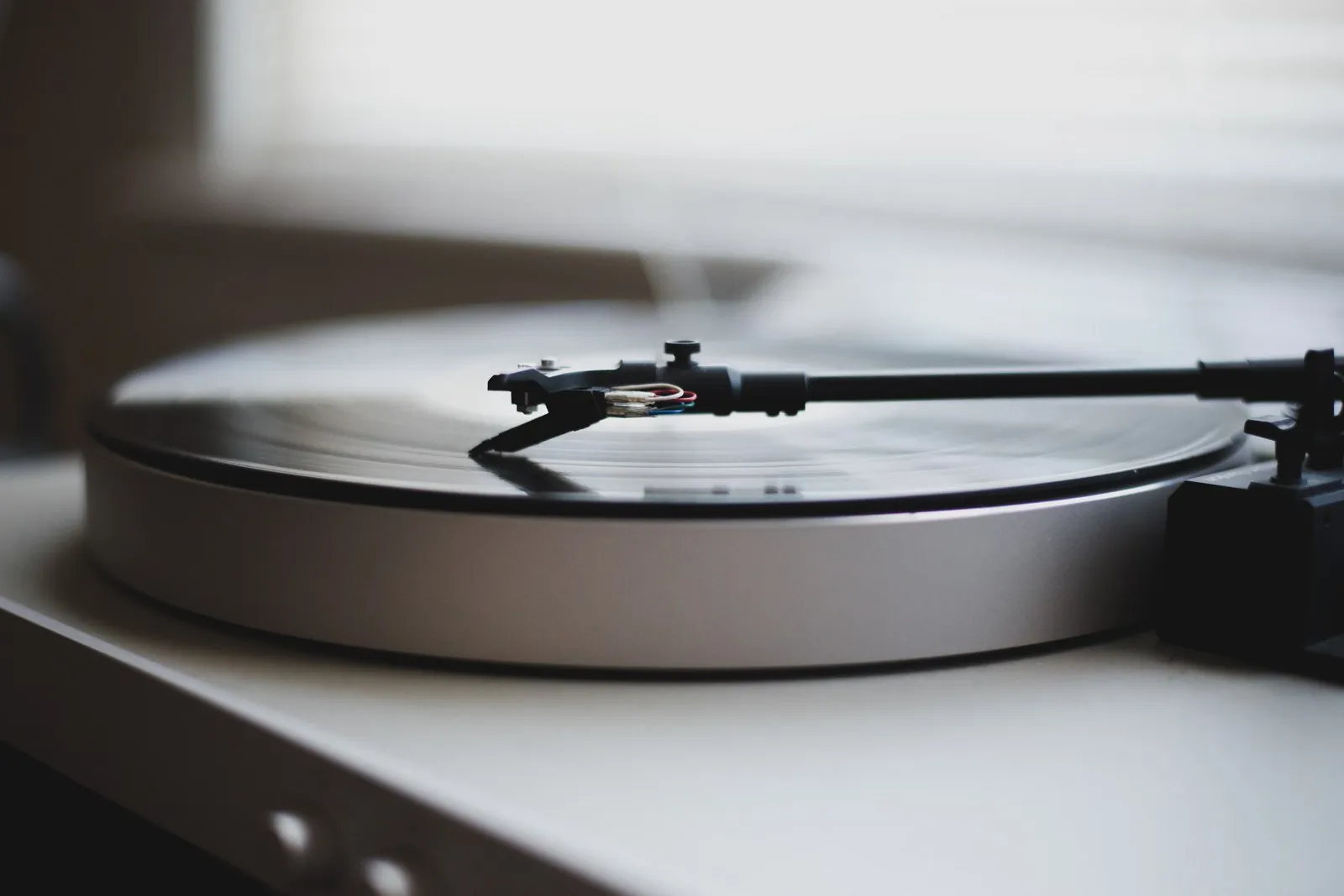
- Hero photo: “Minimal vinyl player” by Lee Campbell, via Wikimedia Commons, CC0 (public-domain dedication). Resized for web display.
Continue reading
- Sufjan Stevens and the architecture of inner light — a longer single-artist piece on Stevens.
- Between Silence and Light: a slow-listening concert — the Stanislovaitis programme reviewed at length.
- Bon Iver and the architecture of emotional safety — an adjacent voice in the same listening posture.
- The Innocence Mission: indie folk that thinks in a quieter sentence — chamber-scale literary songcraft, a Pennsylvania version.