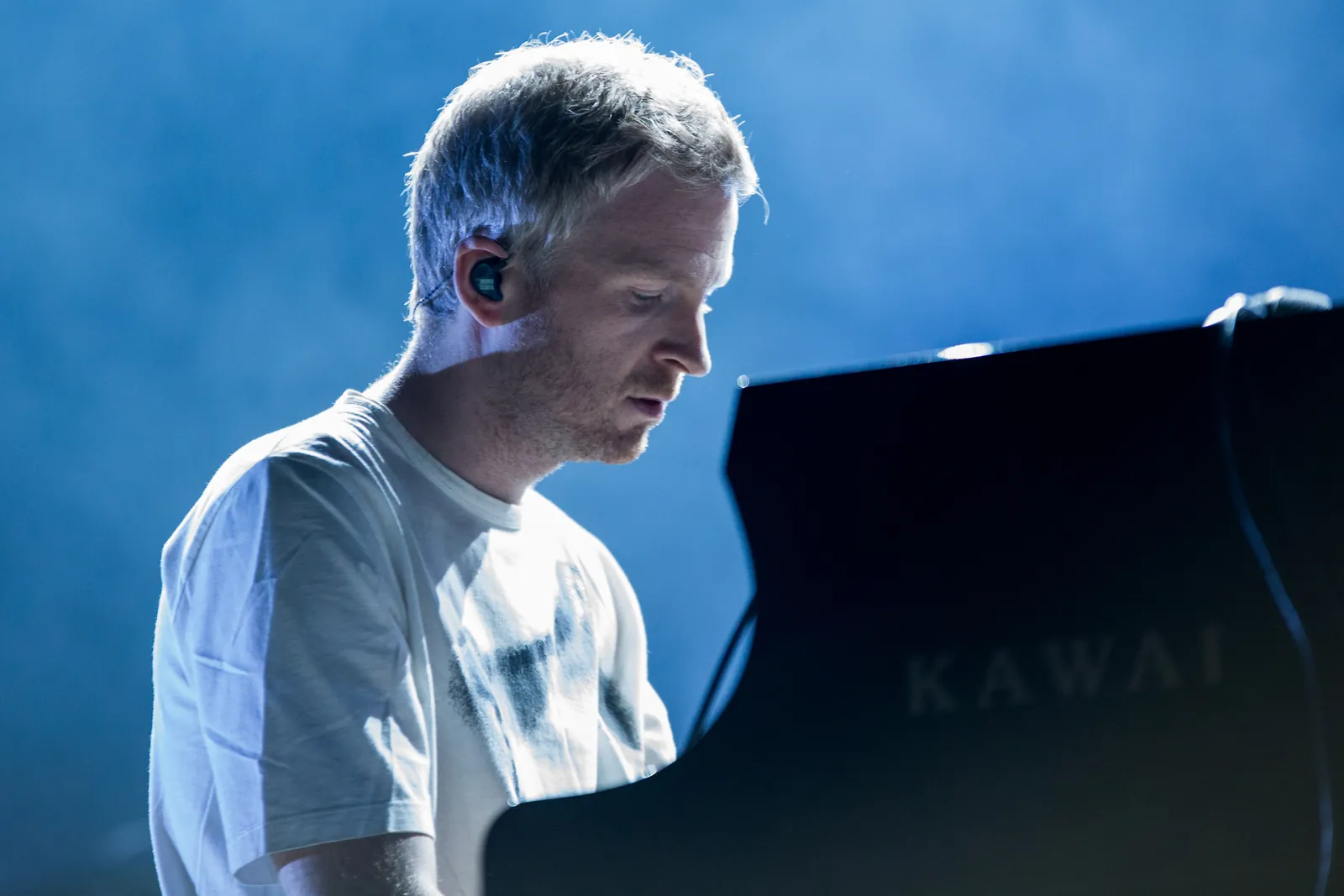
In a Reykjavík studio, two felt-dampened upright pianos play notes that Ólafur Arnalds never touches. He presses a single key on a third piano; the other two answer with cascades he cannot predict, driven by a rhythm formula borrowed from a mathematics teacher. He built the machine after nerve damage from a car accident took the dexterity of one hand and kept him off the piano for about a year — not to replace his playing, but to argue with it. That is the place to start with Arnalds: with the machinery, not the calm it produces. The drummer who came up screaming behind a hardcore kit never left; he simply learned to build systems that engineer the unexpected on purpose, and the hush most listeners hear is the output, not the man.
From the drum riser to the string section
Arnalds began as a teenager playing drums in Icelandic hardcore and metal bands with names like Fighting Shit and I Adapt. His entire neoclassical career started almost by accident: touring in support of the German metalcore band Heaven Shall Burn, he handed them demos of, in his words, “very overly dramatic prog-rock songs”, and they asked him to write the string-and-piano intro and outros for their 2004 album Antigone — gentle interludes folded inside a brutal record. He made the first orchestral sketches with MIDI strings on his parents’ home computer (“pretty horrible-sounding stuff”), then recorded real players — friends on violin and cello, in a living room, through a single Shure SM57 microphone. The loud years never left; they turned into a feel for exactly how much force a moment can bear.
The ghost pianos
The clearest expression of his method is re:member (2018) and the system he calls Stratus. Two Yamaha Disklavier player pianos respond, in real time, to a central piano fitted with a Moog PianoBar that sends out MIDI; software takes each note he plays and redistributes it across the two other instruments, shifting it up or down the octave with a curated degree of randomness, so the same input answers differently every time. The rhythmic engine runs on Euclidean rhythms — an algorithm for spacing beats as evenly as possible — programmed with the Icelandic drummer and computer scientist Halldór Eldjárn over roughly two years. Arnalds is precise about what it is for: “The idea behind this is not to create a computer that makes music for me; it’s to create an instrument that I’m playing.” And about its appeal: “I can’t always predict what the other pianos play.” Wary of gimmickry, he used Stratus on only about half of re:member — “in the end it just sounds like a lot of piano notes” — and even had the album’s cover art generated from the system’s data.
Kiasmos: the other half
The pulse under the “quiet” records has its own home. With the Faroese musician Janus Rasmussen — whom he met in 2009 while working as a sound engineer for Rasmussen’s electro-pop band Bloodgroup — Arnalds runs Kiasmos, a minimal, Berlin-leaning techno duo born on long drives across Iceland. Their self-titled debut (2014) was made in roughly a fortnight; the second album, II, arrived a decade later in 2024, partly written in Bali during the pandemic. The duo’s working rule could be a motto for his whole practice: “there’s no place for ego in the studio”. Kiasmos is not a side project so much as the half of Arnalds that admits the drummer never went away.
Grief, scored
The same craft built one of British television’s most-copied scores. For the ITV drama Broadchurch (2013) Arnalds wrote some four and a half hours of music to a producers’ brief he loved — “be as bold as you possibly can” — including the Beth Latimer theme, a short piano motif that circles a few chords and refuses to resolve. It won the 2014 BAFTA Television Craft Award for Original Music. He has since let slip that the score hides clues to the killer’s identity: across the first series he wrote cues tied to particular characters, so a rewatch turns the music into evidence. It is the engineer’s instinct again — feeling, but built to a structure with a secret inside it.
Every system Arnalds builds has the same hidden purpose: to take the decision out of his own hands, so that something he did not plan can surprise him into feeling.
Systems that ambush the composer
The constraint-as-method runs through everything. Found Songs (2009) was a song a day for seven days; Living Room Songs (2011), seven pieces in seven days filmed live in his apartment; Island Songs (2016), seven weeks travelling to seven Icelandic locations to record with seven different collaborators — a village music teacher, a brass band, a choir, his own sister — each filmed in a single take, rehearsed the same morning. Every one of these is a rule designed to remove a choice. And that is finally what unites the metal drummer, the techno producer, the screen composer and the man with the ghost pianos: a deep distrust of his own control. “I’m really not interested in music written by AI,” he says. “What’s interesting about music, to me, is personal expression.” The machines are not there to compose for him; they are there to provoke him. The most human thing about Arnalds’s music is the elaborate apparatus he uses to ambush himself — the composer standing on stage with his hands waiting, listening for what the pianos will say back, the audience for his own software.
Sources
- Ólafur Arnalds — biography, the metal-band origin, Broadchurch and the BAFTA, the Defending Jacob Emmy nomination — Wikipedia.
- Heaven Shall Burn’s Antigone and Arnalds’s intro/outro — Wikipedia.
- Stratus — the system, the two Disklaviers, the sampled instrument — Spitfire Audio; the injury origin and Euclidean rhythms with Halldór Eldjárn — CDM.
- Arnalds on method, the SM57 living-room sessions, Broadchurch — Sound On Sound.
- Kiasmos with Janus Rasmussen, and II — Wikipedia; “no place for ego” — Qobuz.
- Island Songs — seven weeks, seven locations — CutCommon.
- Stratus and the anti-AI position (quotes) — NBC San Diego.
- Hero photo: “Ólafur Arnalds, Rudolstadt-Festival 2019” by Carsten Stiller, via Wikimedia Commons, CC BY-SA 4.0.
Listen
Three official recordings — the ghost pianos, the duo’s pulse, and a film-scale crescendo.
Continue reading
- Nils Frahm and the engineering of intimacy — the opposite apparatus: hand-built machines played by a body, not by themselves.
- Sebastian Plano: Solo, and being alone with the cello — a fellow neo-classical and electronic composer in intimate terrain.
- Cinematic acoustic pop: four artists — the screen-scale register Arnalds’s film work belongs to.