A toilet brush, dragged across the strings of a Steinway concert grand, its bristles set bouncing to a dub pulse, while the man who put it there sprints across a stage strung with cables to catch a synth loop with his foot. This is the “quiet” pianist at work. The image is worth holding onto, because almost everything written about Nils Frahm files him under hushed, late-night, neo-classical calm — and almost everything about how he actually makes music is the opposite: physical, mechanical, obsessive and, live, close to euphoric. His real subject is not silence. It is the meeting of the body and the machine in the act of making a sound imperfect on purpose.
The felt, and a favour to the neighbours
The sound most people know him for began as good manners. Wanting to play piano late at night without disturbing the people next door, Frahm stuffed thick felt between the hammers and strings and played with very gentle fingers — and then fell for what he heard. On Felt (2011) he pushed the microphones so far inside the instrument that they nearly touched the wires, close enough to capture everything a normal recording is built to erase: his breathing, the creak of the action, the floorboards, the mechanism itself. The music became, in his phrase, “a contingency, a chance, an accident”. It is an aesthetic of proximity, not of perfection — the listener placed not in the tenth row but inside the piano.
An apparatus, mostly self-built
What that intimacy actually rests on is hardware, much of it bespoke. Frahm commissioned the Una Corda from the master builder David Klavins: a 64-key instrument with a single string per note instead of the usual two or three, under 100 kilograms, its thin solid-spruce soundboard left exposed so he can clip scraps of cloth between hammer and string and tune the muffled timbre into the instrument itself. He bought the Roland Juno-60 behind the arpeggio of “Says” for sixty Deutsche Marks as a teenager. In 2016 he took over a chamber-music hall in the old East German broadcasting complex at Funkhaus Berlin and rebuilt it himself down to the cabling and the woodwork; he revived one of the building’s original physical echo chambers for reverb, and for All Melody (2018) decamped to a 1600s stone house in Mallorca to record into a dried well. His mixing desk is a custom, entirely transformer-based board assembled from vintage broadcast modules by an engineer he calls “the Beethoven of vintage modding”. The “intimacy”, in other words, is engineered — and his summary of the whole renovation is pure Frahm: “We spent a lot of money to make it look like we didn’t do anything at all.”
Slow music, played at a sprint
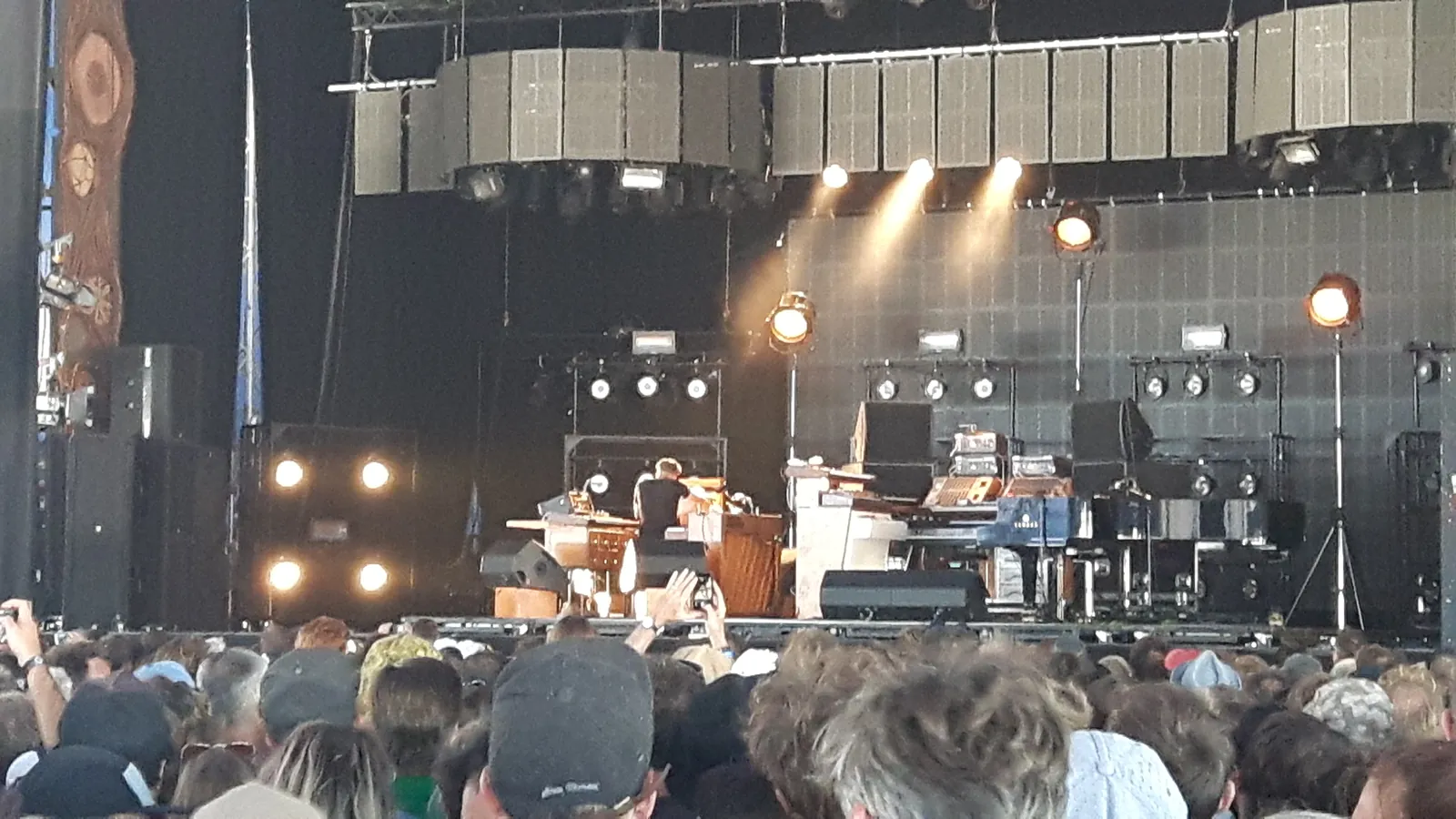
Then there is the live Frahm, who bears almost no resemblance to the candlelit cliché. On stage he is a tip-toeing, perspiring performer who darts between a tight cluster of instruments — several Junos, a Fender Rhodes, a Mellotron, banks of Roland Space Echo tape units wired so he can switch them by physical Arduino boxes — building toward crescendos that pull standing ovations mid-set. Spaces (2013), the record that made his name, is a deliberate anti-live-album: a two-year collage of field recordings from many concerts, takes chosen precisely because they contain audience coughs and a ringing phone, so the room becomes part of the music. A live review of the toilet-brush passage put it best: “There’s something anarchistic about using toilet brushes on a Steinway concert grand, and the novelty definitely hasn’t worn off yet.”
Frahm’s rule is almost a moral one: a recording should never be cleaner than the room it was made in.
Imperfection, fanatically curated
The creed underneath all this is anti-perfection and anti-preset, and he states it bluntly. “I don’t like plug-ins,” he says, “because I can imagine somebody’s using the same preset right now, maybe in Tasmania.” Of digital exactness: “When it actually sounds the same — PCM type of same — then I’m dead. It’s dead air, I feel it with my heart.” And yet the honesty of the piece requires noting the paradox he embodies: the imperfection is meticulously, expensively curated. The man who insisted for years on analogue live mixing “not just because it avoids latency but also because I was convinced that it sounds better than digital systems” eventually toured on a digital console — once its converters had made the latency imperceptible. His 2022 Music for Animals runs past three hours and abandons piano and melody outright, modelled on “watching a great waterfall” — a thing that “doesn’t need an Act 1, 2, 3”. The roughness is real; so is the obsessive control that produces it.
It is fitting, then, that the truest emblem of Frahm is that janitorial brush bouncing on a six-figure grand: the most elaborate analogue apparatus pressed into the cheapest, most absurd, most physical gesture, and a hall on its feet. He founded Piano Day in 2015, on the year’s eighty-eighth day for the piano’s eighty-eight keys, expressly to honour not virtuosos but “performers, composers, piano builders, tuners, movers and most important, the listener”. That is the giveaway. The most radical thing about Frahm was never that he plays softly. It is that he refuses to let a recording come out cleaner than a room actually is.
Sources
- Nils Frahm — “Felt”, his own account of the felt-damping and close-miking — nilsfrahm.com.
- Felt (2011) and Spaces (2013) — releases, the live-collage method, “Says” — Wikipedia: Felt, Wikipedia: Spaces.
- The Una Corda, built by David Klavins — specifications and debut — CDM.
- Saal 3 at Funkhaus Berlin — the self-built studio — Sound On Sound.
- The custom transformer console — Tape Op.
- The live rig and how he plays it — DJ Mag.
- Analogue creed and the Juno-60 — MusicRadar; the digital-console concession — Live Production TV.
- Live review (the toilet-brush passage) — The Line of Best Fit; Music for Animals — Bandcamp; Piano Day — Wikipedia.
- Hero photo: “Nils Frahm at Down The Rabbit Hole 2018” by FakirNL, via Wikimedia Commons, CC BY-SA 4.0.
Listen
The piece that holds the whole method — built on a synth he bought for sixty marks.
Continue reading
- Sebastian Plano: Solo, and being alone with the cello — another close-miked solo instrumentalist who records the body, not just the notes.
- Ólafur Arnalds and the engineering of feeling — the opposite apparatus: machines built to play themselves.
- Between Silence and Light: Justinas Stanislovaitis — a seated programme that shapes a room with restraint.